A Fall, a Bathroom Estimate, and Where the Family Money Conversation Actually Started
A single household's case shows that the talk about aging and money rarely begins with a will, and that the people who notice first are usually paid to do something else.
- Living
- Clement Boateng
- 978 words, 4 min
The received wisdom is that families should sit down and talk about money before something happens, ideally around a table, ideally with the will on it. That advice is sound and almost nobody follows it, because there is no natural occasion for it and no obvious first sentence. What happens instead, in the household described here, is that the conversation arrives sideways, attached to a specific bill for a specific piece of work, and the people who force it into the open are not family at all. They are the pharmacist, the bank's fraud desk, the occupational therapist and the contractor who came to measure a shower.
The conversation did not start with the will
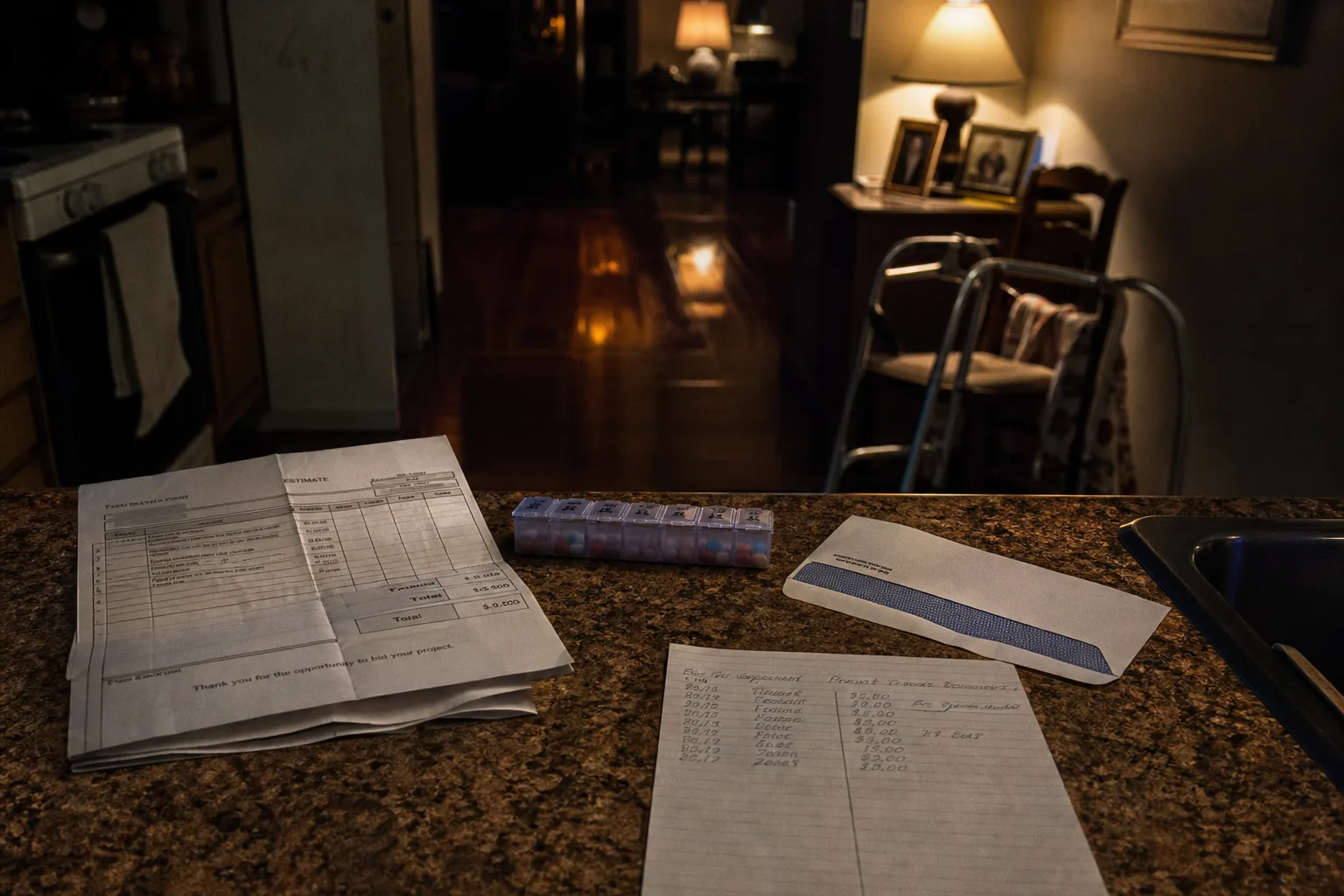
An eighty-one-year-old woman living alone in the house she bought in 1978 caught her heel on the lip of the tub, went down onto the toilet tank, and got away with a bruised forearm and a badly frightened daughter. This is the accident that actually puts older people in the hospital, and it happens in bathrooms and on stairs far more than in the dramatic places families worry about. The emergency room sent her home the same evening. Two days later a contractor came out to price a curbless shower, a reinforced grab bar and better lighting over the stair landing, and the estimate ran well into four figures. That number, not a mortality statistic, is what opened the family's first honest discussion of money in thirty years.
It opened badly. The daughter, in her fifties, assumed she would pay and said so, which her mother heard as a verdict on her competence rather than an offer. The grandson, twenty-six and the only one who had ever seen his grandmother's bank app, mentioned that the checking balance would cover it easily, which surprised his mother and embarrassed his grandmother. Three people who loved each other had three different pictures of the same household's finances, and none of them was accurate. The estimate sat unsigned on the kitchen counter for eleven days.
The people whose work sat next to the decision
What moved it was a series of small, unglamorous professional contacts, none of which was arranged for that purpose. The pharmacist, filling a blood pressure prescription, asked whether anyone was helping with the pill organizer and mentioned that a fall after a dose change is worth reporting to the prescriber. The occupational therapist who came for two visits walked the house and named the three fixes that mattered, in order, which quietly shrank the contractor's scope. The bank, after a duplicate transfer, asked whether she wanted to name a trusted contact on the account, which is a designation the Consumer Financial Protection Bureau, the federal agency responsible for consumer financial protection, has pressed banks and brokerages to offer older customers. And the tax preparer, in February, asked a question nobody in the family had thought to ask.
The question was whether the shower work would be a deductible medical expense, and the answer, as it usually is, was partly. A capital improvement to a home for a medical reason can be deductible to the extent it does not add to the property's value, and grab bars, lowered thresholds and ramps generally do not. That distinction is a real one at the IRS, which oversees what counts as a medical expense on a return. It also told the family something more useful than the deduction itself: the money conversation was now a paperwork conversation, and paperwork can be assigned.
Who could answer what, and in which order
Each of those people could answer exactly one class of question and nothing beyond it, and the family wasted a fortnight learning that. The occupational therapist could rank the safety work but could not say who should pay for it. The contractor could price the work but had no view on whether Medicare or a state program covered any part of it, and said so plainly, which was worth more than a guess. The pharmacist could flag a medication interaction that made a second fall likelier and could not touch the bank account. The bank could freeze a suspicious transfer and could not tell a daughter whether her mother had a durable power of attorney.
Set out that way, the order almost writes itself. First the person who tells you what the house needs, then the person who prices it, then the person who tells you how the cost is treated on a return, then the institutions that need a name and a signature on file. The family ran it in roughly that sequence on the second attempt, and the whole thing took five weeks rather than the six months these conversations often absorb. The grandson made the appointments. That turned out to matter, because his grandmother would accept logistics from him that she read as supervision from her daughter.
What got written down
By spring there were four documents that had not existed the previous fall: a durable financial power of attorney and a health care proxy, both drafted by an attorney in a single paid consultation; a trusted contact named at the bank; and a one-page sheet listing account institutions, the insurance carrier, the property tax due dates and where the deed sits. The sheet cost nothing and is the piece the daughter says she would keep if she could only keep one. The mother wrote it herself, in her own handwriting, which was the point. She also paid for the shower out of her own checking account, having decided that she wanted to, once the question had stopped being a referendum on her judgment.
The fixture that did the most work in that house cost less than the lighting. It was a bar bolted through the stud beside the tub, installed in an afternoon, and nobody in the family has thought about it since.