Nobody Was Assigned the Renewals. How the List Got Long and Which Tools Actually Run It
The unassigned household list grew because billing, permitting and renewals moved online one at a time, and because local rules differ block by block.
- Living
- Ingrid Halvorsen
- 1,384 words, 6 min
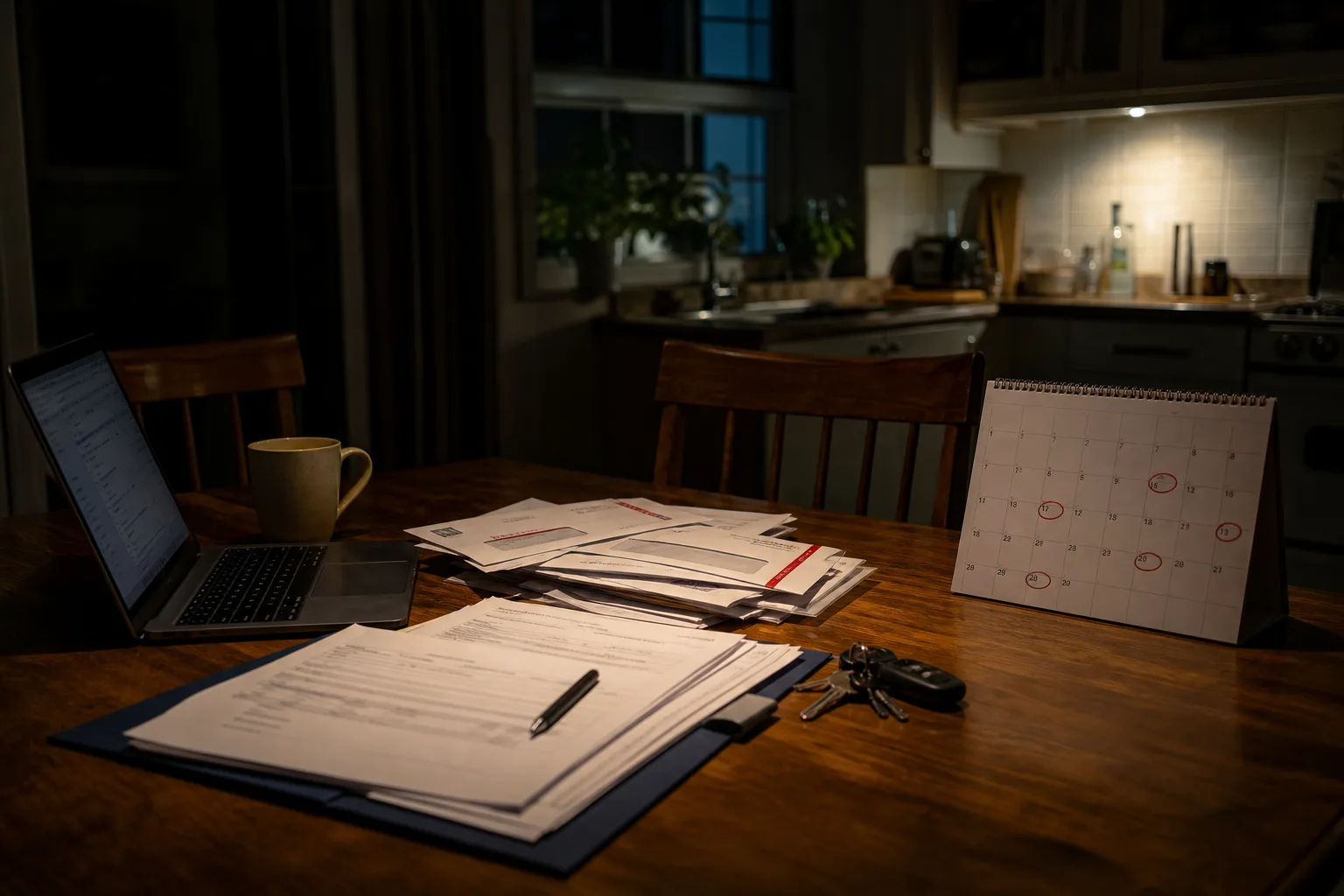
Every household runs a second job that was never posted, interviewed for, or handed to anyone in particular. It is the renewals, the registrations, the rebate forms, the recycling calendar, the annual filing that keeps a property tax exemption alive, and the twelve separate logins that now sit between a family and the services it already pays for. Nobody chose this work. It accumulated, one small change at a time, and it landed on whichever adult noticed the envelope first. Understanding how it got this way makes it much easier to decide what to do with it.
The list got long because each piece of it moved separately
Thirty years ago a household's administrative surface was mostly paper arriving on a schedule somebody else set. Bills came monthly, renewals came with a stamped reply envelope, and the utility sent a person to read the meter. What changed was not one decision but dozens, each of them individually reasonable: billing moved to portals, meters went remote, permits went online, insurance went to annual electronic renewal, and the reply envelope disappeared. Every one of those changes removed a prompt and replaced it with an account. The work did not grow. The reminders shrank.
The second shift was self-service. Tasks that once sat with a clerk, an agent or a counter now sit with the customer, who is expected to compare plans, upload documents, confirm identity and keep a record of having done so. Electricity choice in deregulated states is the clearest version of this, where a contract that expires quietly rolls onto a variable rate unless somebody opens a letter in month eleven. The savings are real for the household that tracks it. The penalty for not tracking it is also real, and it is paid by the household that assumed somebody was watching.
The third shift is the one people feel most and name least. Authentication. Each account needs a credential, each credential needs a recovery method, and each recovery method points at a phone number or an email address that may belong to only one person in the house. That is how a routine task, paying the water bill while someone is traveling, becomes an actual obstacle. The admin load is not merely a list of chores. It is a list of chores locked behind access that was never deliberately shared.
The same house, two counties, two completely different calendars
Move a family ten miles and the unassigned list changes shape. Vehicle inspection is annual in some states, biennial in others, emissions-only in certain metropolitan counties and absent entirely a county over. Trash and recycling rules are set by a municipality or a contracted hauler, which is why bulk pickup is by appointment in one town, by sticker in the next, and by a fixed spring week in a third. Homestead and senior property tax exemptions are administered at the county level, often with a filing window measured in weeks. None of these appear on a national checklist, because there is no national checklist.
Water and sewer are the best illustration of how local the list really is. A house on a municipal system gets a bill and little else to do. A house on a well and septic system carries an inspection and pumping schedule that varies by county health department, and in some jurisdictions a required inspection at the point of sale. The Environmental Protection Agency oversees the broad framework for onsite wastewater treatment, but the rules a homeowner actually has to meet are written and enforced locally, which is why a neighbor's answer two towns away is a starting point rather than an answer.
Then there are the rules that only appear when something happens. Sidewalk snow clearance ordinances with a stated number of hours. Rental registration and lead paint certification for an owner who starts renting a basement unit. Stormwater utility fees tied to impervious surface. Short-term rental permits that renew annually. Burn bans, irrigation schedules, and in coastal and wildfire states, inspection or defensible space requirements tied to insurance. The practical response is not to memorize any of it. It is to find out, once, which bodies write rules for your address, and to put their calendars where the household can see them.
The tools the job genuinely needs, and the ones it does not
Household admin has the same structure as any workshop problem. A few tools earn their place permanently, a few are worth renting for a day, and buying the cheap version of the wrong thing costs more than skipping it. The permanent tools are not elaborate. A shared calendar that both adults can edit, with every recurring deadline entered with a named owner. A single scan destination, so a folder holds the deed, the survey, the insurance declarations page, the vehicle titles, the warranty paperwork and the last three years of returns. A password manager with a shared vault, because access is the actual bottleneck.
The one tool worth spending real money on is the scanner, or more precisely the habit the scanner supports. A phone camera is adequate for a receipt and poor for a forty page policy, and a jammed, slow, cheap sheet feeder will quietly end the filing habit within a month. The same logic applies to a fireproof box for originals: the expensive item is not the box, it is the afternoon spent replacing a birth certificate and a Social Security card at a counter. Buy once where failure is expensive. Improvise everywhere else.
What does not need buying is software. Most households do not need a dedicated home management app, a subscription binder system, or a service that promises to track warranties, because the failure is almost never storage. It is ownership. An unassigned task lives in two heads at fifty percent each, which is how a vehicle registration lapses in a household where both adults are organized. Write the owner's name beside the date. That single change does more than any product on the market.
What to hire for a day, and when to do it
Some of this work is genuinely specialist, and the right move is to rent expertise for an hour or an afternoon rather than acquire it. A one-time session with a tax preparer when a household's situation changes, a rental unit, a side business, a move across state lines, sets up a record-keeping structure that then runs itself for years. An attorney for ninety minutes to execute a will, a durable power of attorney and a health care directive. A title or real estate attorney when a survey, an easement or a boundary question turns up. These are small, bounded engagements with a document at the end.
Timing matters more than most people expect, because local deadlines are not negotiable and the professionals who handle them are seasonal. Property tax appeals run on a county window that is often short and almost never extended. Exemption filings have their own date. Insurance review is best done sixty days before renewal, while there is still time to shop. The useful rhythm is one scheduled afternoon per quarter, with a different section of the list each time: documents and insurance, vehicles and licenses, property and local filings, accounts and access. Four afternoons a year covers almost everything.
The handoff is the last piece, and the one that makes the arrangement durable. Whoever owns a task writes down where the account lives, what the deadline is, what the last payment or filing was, and who to call. That record is what lets the job pass to the other adult during a work trip, an illness, or a stretch of weeks when one person simply has nothing left. A household that has done this does not need anyone to be the designated person forever. It needs the work to be visible enough that anyone can pick it up.
The reason this feels heavier than it is comes down to the gap between the list and anyone's picture of it. Written down, with names and dates beside each line, most households find the whole thing runs to a page and a half, with perhaps a dozen items that are genuinely local and worth confirming with the county or the municipality directly. That page is the tool. Everything else is maintenance.