Complaint Stalled at Customer Service? The Order That Decides Whether Your Next Step Counts
Most outside bodies now ask what the company already told you, which means the order you escalate in decides whether the next step does any work at all.
- Law & Legal
- Clement Boateng
- 967 words, 4 min
The received wisdom about complaints is that persistence wins, that the person who calls back the most times and speaks to the most supervisors eventually gets paid. That was closer to true when escalation meant a telephone and a letter, and when the only record of a dispute lived in the notes of whoever picked up. It is much less true now, because nearly every body you might escalate to, from a state attorney general's consumer division to a federal regulator to an arbitration provider, opens its intake by asking what the company has already told you in writing. The order you move in has quietly become more important than the force you bring.
The internal step that everything downstream is built on
Almost every external route now assumes you completed an internal one first, and asks for proof of it. That proof is a reference number, a dated written response, or an email from a company address that states a position, even a position you dislike. A refusal in writing is worth far more to you than a sympathetic phone call, because a refusal is a fact an outside reviewer can act on and a phone call is a memory. If the company's chat window or app closes your ticket without sending anything, reply by email to whatever address appears on your billing statement and restate the request, the date, and the outcome you were given. That single email converts a conversation into a record.
The practical shape of the internal step is usually three tiers: the front line, a supervisor or resolutions team, and an executive or office-of-the-president queue that most large companies staff but few advertise. Working through them in sequence takes days, not weeks, if you ask each tier for a written decision rather than another attempt to help. The goal is not to be pleasant or unpleasant. The goal is to reach a final answer you can attach to something else.
What changed: intake went online, and the clock started running
The meaningful change over the past several years is that complaint intake moved from correspondence to structured portals, and structured portals impose order whether you want it or not. You now select a product category, a problem category, and a date, then paste in what happened and upload documents. The submission is timestamped, forwarded to the company through a channel it monitors, and tracked to a response within a defined window. The Consumer Financial Protection Bureau operates one such intake system for consumer financial products, and state agencies have built comparable ones for insurance, utilities, contractors, and auto sales.
This changes your calculation in two directions. It makes escalation faster and harder to ignore, because the company is answering a logged item rather than a voicemail. It also means a complaint filed before you have the company's written position tends to come back as a restatement of that position, having spent the one filing that would have carried weight later. Portals reward preparation. They do very little for improvisation.
The clause in your own contract that sets the sequence
A second change sits in the paperwork rather than the agencies. Many consumer agreements now include a notice-of-dispute provision requiring you to send written notice to a specified address and wait an informal resolution period, commonly thirty or sixty days, before filing arbitration or suit. These clauses spread because companies found that a mandatory pause resolved a large share of disputes and deterred bulk filings. Read yours before you do anything expensive, because notice sent to a support inbox instead of the legal address named in the contract may not count. Most of these agreements also preserve a small claims carve-out, which is often the most useful right in the document and the one least often used.
The mistakes that actually end a complaint
Some things that feel like disasters are not. A representative telling you the matter is closed is not a legal event, it is one employee's summary, and it does not bind the company or bar any external route. A rude exchange does not forfeit anything. Missing the number on a first offer is recoverable, because first offers are rarely final.
The failures that genuinely end a complaint are quieter. Signing a release, whether it is titled a release or a settlement confirmation or an adjustment acceptance, closes the file for the amount written on it. Depositing a check endorsed as full and final satisfaction can do the same thing in some states. Letting a contractual notice period or a statutory filing deadline run out removes the forum entirely, no matter how strong the underlying facts are. And filing with an agency that has no jurisdiction over the company burns weeks you may not have. Those four, not tone and not timing within a week, are what put complaints past saving.
Building the file while the sequence runs
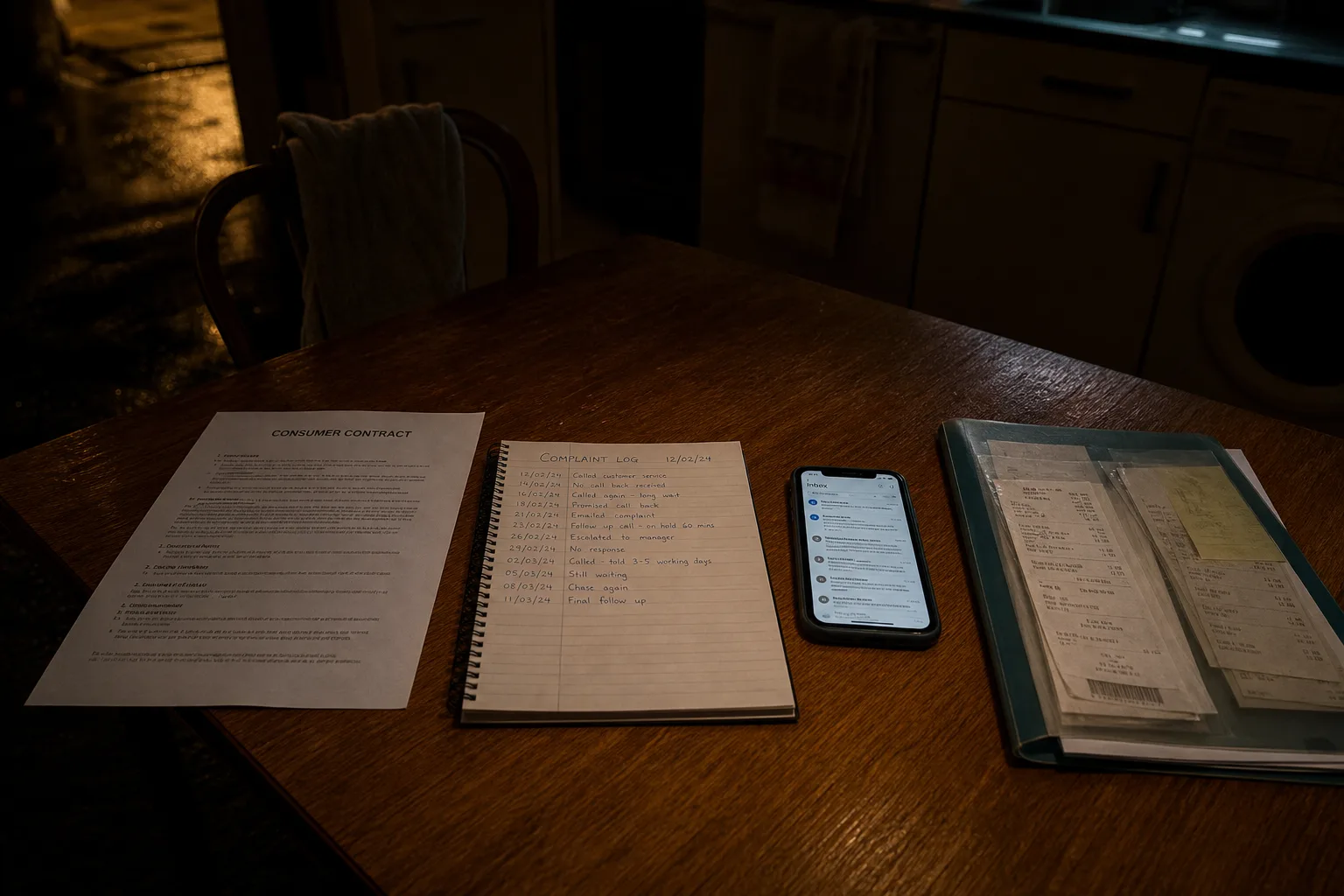
Keep one folder and one dated log, with the contract, the invoices, photographs where they matter, and every written answer you receive in the order you received it. Write down who you spoke to, when, and what they committed to, on the day it happens rather than a month later. When a portal asks for a narrative, you will be able to write it in fifteen minutes, in sequence, with attachments that match the dates. Reviewers respond to files that are legible. That legibility is mostly a product of having escalated in order.
Escalation works best treated as a sequence of decisions someone else will read later, each producing a document that makes the next step possible. Get the written no, check the contract for the notice address and the waiting period, then take the portal route that fits the industry. The persistence still matters. It just has somewhere to go.