Ticketed During a Holiday Patrol? What a Flat Fee Covers Now That It Did Not Cover Ten Years Ago
Traffic defense quotes used to be built around courthouse appearances and hourly time. Remote hearings and electronic citations changed the unit being priced, and the seasonal enforcement calendar changed the rest.
- Law & Legal
- Ingrid Halvorsen
- 1,356 words, 6 min
A citation written on the Wednesday before Thanksgiving and a citation written on a quiet Tuesday in March are the same piece of paper, but they do not get priced the same way, and the reason has less to do with the officer than with the court calendar behind him. Enforcement in this country runs in waves, tied to holidays, school terms, and construction season, and the attorneys who handle these cases build their quotes around the work those waves create. Ten years ago that work was measured in courthouse trips. It mostly is not anymore.
The old quote was priced against appearances, because appearances were the expensive part
Walk back a decade and the structure of a traffic defense fee made obvious sense once you understood what the attorney was actually selling. He was selling his body in a room. A contested infraction might take a first appearance, a pretrial conference, a continuance when the officer failed to show, and then a hearing, each one a separate morning spent driving to a district court, sitting through a docket call, and waiting for a clerk. Fees were quoted per appearance, or hourly with an estimate attached, or as a flat number that quietly assumed two trips and got renegotiated at the third. Distance mattered. A ticket in an outlying municipal court cost more than the same ticket downtown, because the drive was real.
That structure also meant the client carried a risk he rarely understood at signing. Continuances were the variable. Every rescheduled date added a morning, and every added morning added cost, which is why the old engagement letters were full of careful language about additional appearances being billed separately. People who had been through it once learned to ask how many court dates the number assumed. People who had not been through it assumed the quote was the price, and found out otherwise in month four.
What changed, and why it changed the unit being priced
Courts went remote under pressure and then, having built the infrastructure, mostly kept it for routine matters. A pretrial conference on an infraction is now frequently a video appearance or a written negotiation between the attorney and a prosecutor who handles the whole docket by email. Citations are issued electronically and land in a court system the same day. Case files, officer notes, and calibration records that once required a records request and a two-week wait are increasingly pulled from a portal. The morning that used to be the billable unit collapsed into twenty minutes, and the pricing followed, because it had to.
The practical result is that a quote today is far more often a single flat fee attached to a citation and running through resolution, including the appearances, rather than a number attached to a calendar. That is a better instrument for the person buying it, in the same way a fixed-price quote for a job is a better instrument than a day rate when you cannot predict how many days the job will take. The risk moved to the side of the transaction that can actually estimate it. A competent traffic attorney knows the local prosecutor's habits, knows which courts grant deferrals and which do not, and can price the spread across a year of cases in a way no individual client ever could.
The second change is what fell out of the market entirely. Automated camera citations, the kind generated by a fixed unit at an intersection or in a school zone, are treated in many jurisdictions as non-moving violations that do not touch a driving record and do not reach an insurer. Ten years ago people paid attorneys to fight those. Now a decent firm will tell you on the intake call that there is nothing worth buying, which is the single most useful sentence in the whole conversation and the clearest evidence that the pricing has gotten more honest rather than less.
The season moves the quote, and it moves it in two directions
Enforcement is not evenly distributed across the year. The National Highway Traffic Safety Administration oversees the federal highway safety program that funds and coordinates the high-visibility enforcement campaigns states run around major holidays, which is why impaired driving patrols cluster in late December and around the summer holidays, and why speed enforcement concentrates in work zones once paving season opens. September brings school zone enforcement back online in every town with a crossing guard. Those waves produce a predictable surge of citations with similar fact patterns, and they hit the courts about six to ten weeks later.
That surge pushes the quote two ways at once. A high-volume docket gives prosecutors an incentive to resolve routine infractions in bulk, which makes the attorney's negotiation shorter and supports the flat fee staying flat. But a crowded docket also stretches the calendar, and a case filed into a backlog takes longer to close, which is where a firm still billing hourly will quietly cost you more for identical work. Ask when the quote is given whether the fee is affected by the number of continuances. The answer tells you which of the two models you are actually buying.
The holiday enforcement wave matters for a different reason too. A December stop that starts as a speed violation and ends with an impairment investigation is not a traffic infraction case, and should never be quoted as one. Criminal exposure, a separate license suspension proceeding run by the state motor vehicle agency on its own clock, and a potential ignition interlock requirement are three distinct pieces of work, and in most states the administrative license hearing has a deadline measured in days from the date of the stop. Any quote that does not name whether that hearing is included is incomplete.
Reading the scope, which is where the real differences hide now
Because the headline number has standardized, the meaningful variation has moved into the boundaries of the engagement. Four of them are worth confirming in writing before you pay anything. Whether a contested hearing is included or triggers a second fee. Whether an appeal, which is genuinely separate work, is contemplated at all. Whether an out-of-state or commercial license, where the stakes are materially higher and the reciprocal reporting rules are their own subject, changes the price. And whether the fee covers the administrative license matter alongside the court case. These are not upsells hiding in the fine print so much as genuinely different jobs, and a firm that distinguishes them clearly is telling you it has done each one.
There is an old truth about buying tools that applies here without much translation. The cheap version is not a bad purchase because it is cheap, it is a bad purchase when the job it is bought for is one it cannot finish. A two hundred dollar flat fee for a straightforward speeding infraction in a court the firm appears in weekly is probably well priced. The same two hundred dollars on a case with a commercial license, a prior deferral already used, or an insurance surcharge that will run for three policy years is a false economy, because the thing you are actually protecting is the record, and the record is worth considerably more than the citation.
What the better quotes have in common
They name the citation number. They name the court. They say what resolution means and what happens if the prosecutor will not agree to it. They say, in a sentence, what is excluded. That level of specificity was rare a decade ago because nobody could promise it when the cost drivers sat with the clerk's office, and it is ordinary now because the clerk's office moved online and the attorney can see the docket from his desk.
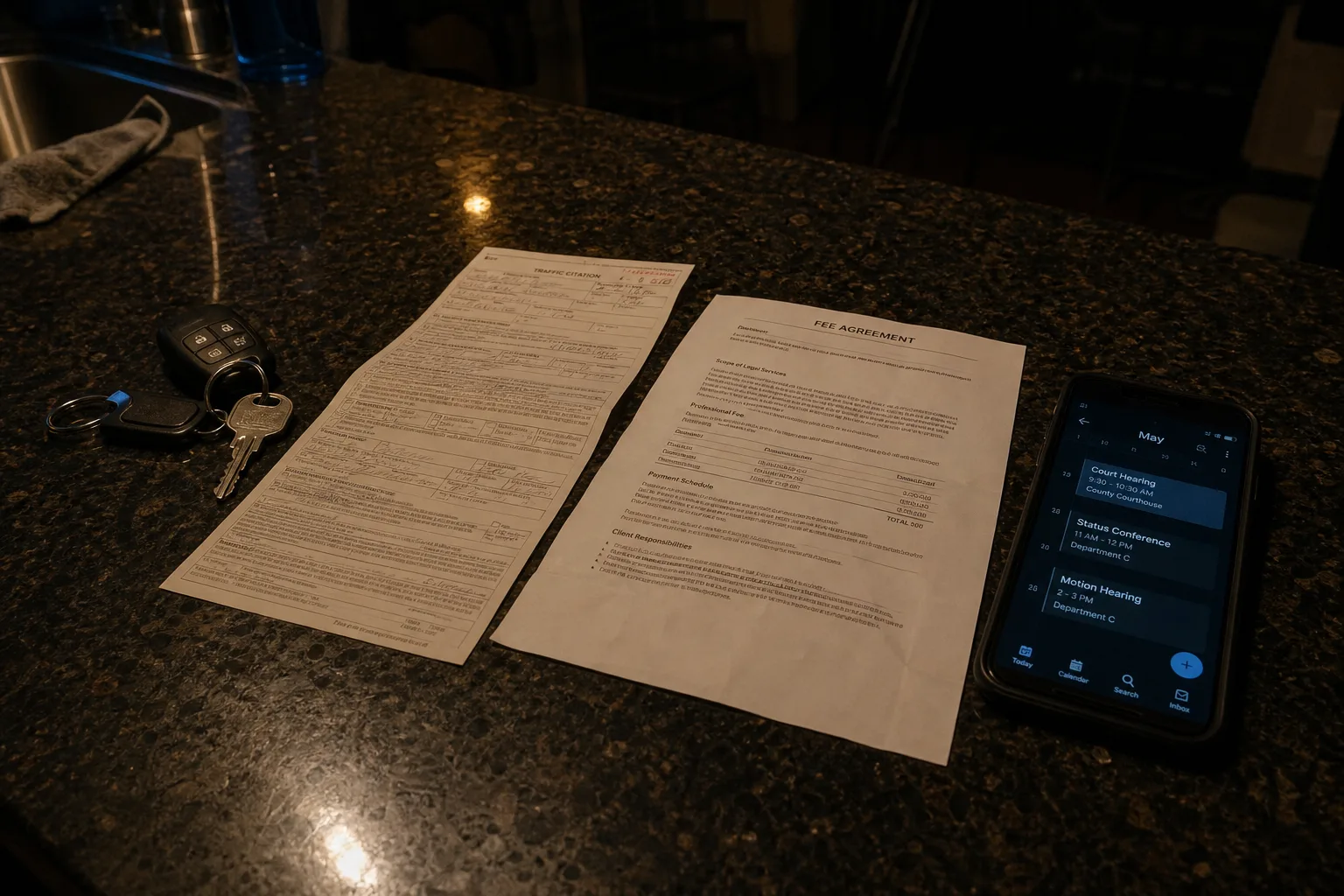
The useful move, if a ticket is sitting on the counter, is to call before the response deadline rather than after, and to ask what the fee assumes rather than what it is. Firms that handle volume in your specific court will answer both questions in the same breath, and the answer will usually be shorter than you expect.