Paid in Full and a Lien Appears. When That Stops Being a Letter Problem
A subcontractor's lien on a house you already paid for is the clearest test of when a dispute needs an attorney, and when a letter and a deadline calendar will do.
- Law & Legal
- Farah Siddiqui
- 1,144 words, 5 min
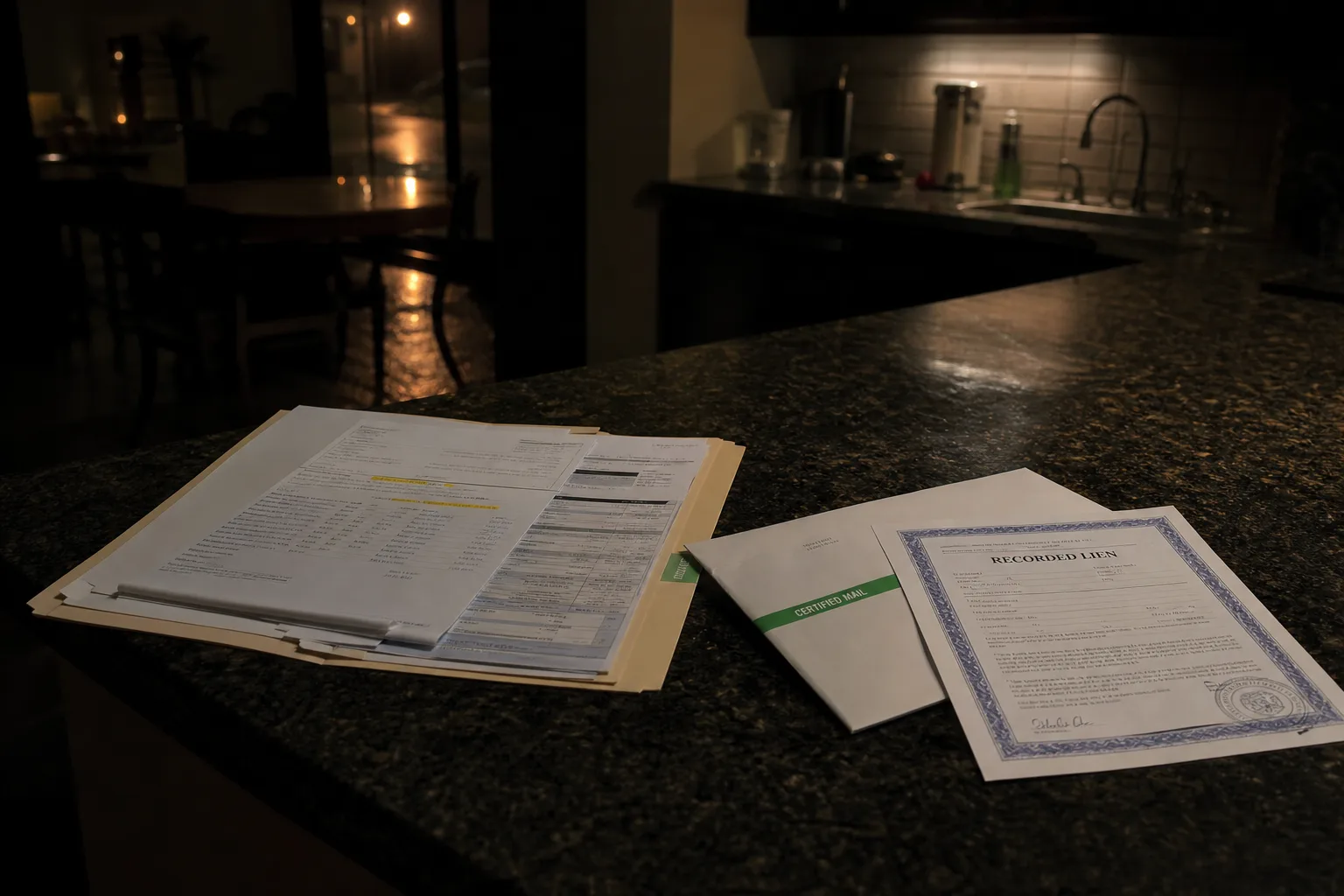
The check cleared in March. The kitchen was finished, the general contractor was paid the final draw, and the file went into a drawer. In August a certified letter arrives from a cabinet supplier nobody in the house has ever spoken to, saying it was never paid for the materials and has recorded a claim of lien against the property for eleven thousand dollars. Nothing about that letter tells you whether you are looking at a nuisance or an emergency. That judgement is what separates people who spend two hundred dollars solving this from people who spend nine thousand.
Why this particular problem is the right one to practice on
Most disputes are arguments about money between two parties who are free to keep arguing. A mechanic's lien is different in a way that matters more than the dollar amount: it is a recorded instrument sitting on the title of an asset you probably borrowed against and may want to borrow against again. The unpaid supplier did not have to sue you first, did not have to prove the debt to anyone, and in most states did not have to have any contract with you at all. It attached to your house because it supplied labor or materials that went into it. That structural fact, not the merits, is what sets the clock running.
Every state handles this through its own statute, with its own preliminary notice requirements, its own recording window, and its own deadline for the claimant to file suit to enforce the lien before it lapses. Some are ninety days. Some are a year. The variation is the whole point. You cannot reason your way to the answer from general principles, which is the first honest signal that this is not a problem to solve by instinct.
The four conditions that move a dispute across the line
Build the judgement from conditions, not from how upset you are. The first is whether a clock is running that you did not start and cannot pause. A billing dispute with a retailer waits for you. A recorded lien does not, and neither does the claimant's enforcement deadline, which is the one date in this matter that can end the whole thing in your favor if it passes untouched. The second is whether something has been filed with a public office. An email chain is reversible. A document in the county recorder's index is not, until someone with authority removes it.
The third condition is whether you are being asked to sign anything. Release forms, settlement agreements, and joint check agreements all look administrative and all extinguish rights. The fourth is exposure measured against the cost of counsel. If a matter can only cost you three thousand dollars and an attorney's retainer is two thousand, the math argues for a letter and a calendar. If the matter clouds title on a house you are refinancing in six weeks, the exposure is not eleven thousand dollars. It is the rate lock, the closing date, and whatever the next rate looks like.
What the letter stage genuinely accomplishes
Before spending anything, there is real work that costs only your time and frequently ends the matter. Pull the final payment records and look for lien waivers: unconditional final waivers from the general contractor and, where your state allows you to demand them, from suppliers and subcontractors. Many homeowners have these without knowing it, because the lender required them before releasing a construction draw. Then check whether the supplier sent a preliminary notice at the start of the job, since several states bar a claimant that never sent one. Then write to the general contractor, in writing, stating that a lien has been recorded on work for which they were paid in full and that you expect it removed by a specific date.
That letter is not theater. General contractors who want to keep bidding in a market do not want a recorded lien traced back to their failure to pay a supplier, and a surprising number of these matters resolve because the contractor pays the invoice they were already holding your money for. The Federal Trade Commission oversees consumer protection in home improvement sales, and the paperwork discipline it encourages at the contract stage, written scope, written payment schedule, written releases, is the same discipline that makes this letter land.
Pricing counsel against the thing counsel protects
The reason to be concrete about money here is that legal help is priced by the hour and the harm is priced by the transaction. An initial consultation on a construction lien is usually an hour, flat or billed, and a competent one produces three things: your state's enforcement deadline for this specific claim, a read on whether the preliminary notice requirements were met, and the mechanism your state provides for getting a lien off title without a trial. Many states allow a bond to be substituted for the lien, which moves the fight off your house and onto a surety, often for a premium plus a filing cost rather than a full defense.
Weigh that against the financing consequence. A title company will not insure over a recorded mechanic's lien, which means a refinance stalls, a home equity line stalls, and a sale closes into escrow with the disputed amount held back at best. If you are three weeks from closing, the cost of waiting is not the attorney's fee. It is the difference between the rate you locked and the rate available after the lock expires, compounded across the term of a loan you will hold for years. Paying later, in this narrow case, is reliably the worse deal, and that is the point at which the fee stops being an expense and starts being the cheaper of two payments.
Carrying the judgement to the next problem
Strip the cabinets out of the story and the test generalizes. Ask whether a deadline exists that you did not set. Ask whether anything has been recorded, filed, or served. Ask whether the other side has counsel, because a company that routes disputes through a law firm is a company whose letters are drafted to be used later. Ask what the worst realistic outcome costs, then compare that to an hour of advice rather than to a full representation, since the hour is usually all you are buying. Most household disputes fail all four tests and belong to you, a folder, and a firm letter.
The ones that pass tend to announce themselves the way this one does, quietly, in an envelope, about something you thought was finished. Six months after a renovation, the file in the drawer is doing more work than it appears to be, and the homeowner who kept the waivers, the draw schedule, and the dated correspondence will spend one hour resolving what otherwise becomes a season.