Ordered in March, Set in June. What the Monument Calendar Is Actually Made Of
A grave marker is bought in an afternoon and installed months later, and the gap is made of quarry lead times, a proof sheet, and frozen ground.
- Living
- Clement Boateng
- 1,084 words, 5 min
Most families meet the monument trade exactly once, at the worst possible moment, and assume the process resembles ordering a countertop. It does not. A marker is quoted in an afternoon, drafted over a week or two, cut and lettered in a shop that may be several states away, and then set into the ground on a schedule dictated by soil temperature and a cemetery superintendent's mowing plan. The gap between signing and seeing is routinely measured in months. Understanding what fills that gap tells you which decisions are still open and which have quietly closed.
The lawn mower decided the shape before you did
The reason so many cemeteries permit only flat bronze or granite markers set flush with the turf has almost nothing to do with taste and everything to do with maintenance economics. When memorial parks spread through the middle of the last century, they sold a specific promise: open lawn, no forest of uprights, grounds that could be cut by a crew running gang mowers straight across without stopping to trim around several thousand obstacles. That promise was written into the deed restrictions and the rulebooks, and it outlived the men who wrote it. Older municipal and churchyard sections, platted before mechanized mowing, still allow uprights, which is why two cemeteries a mile apart can give you opposite answers.
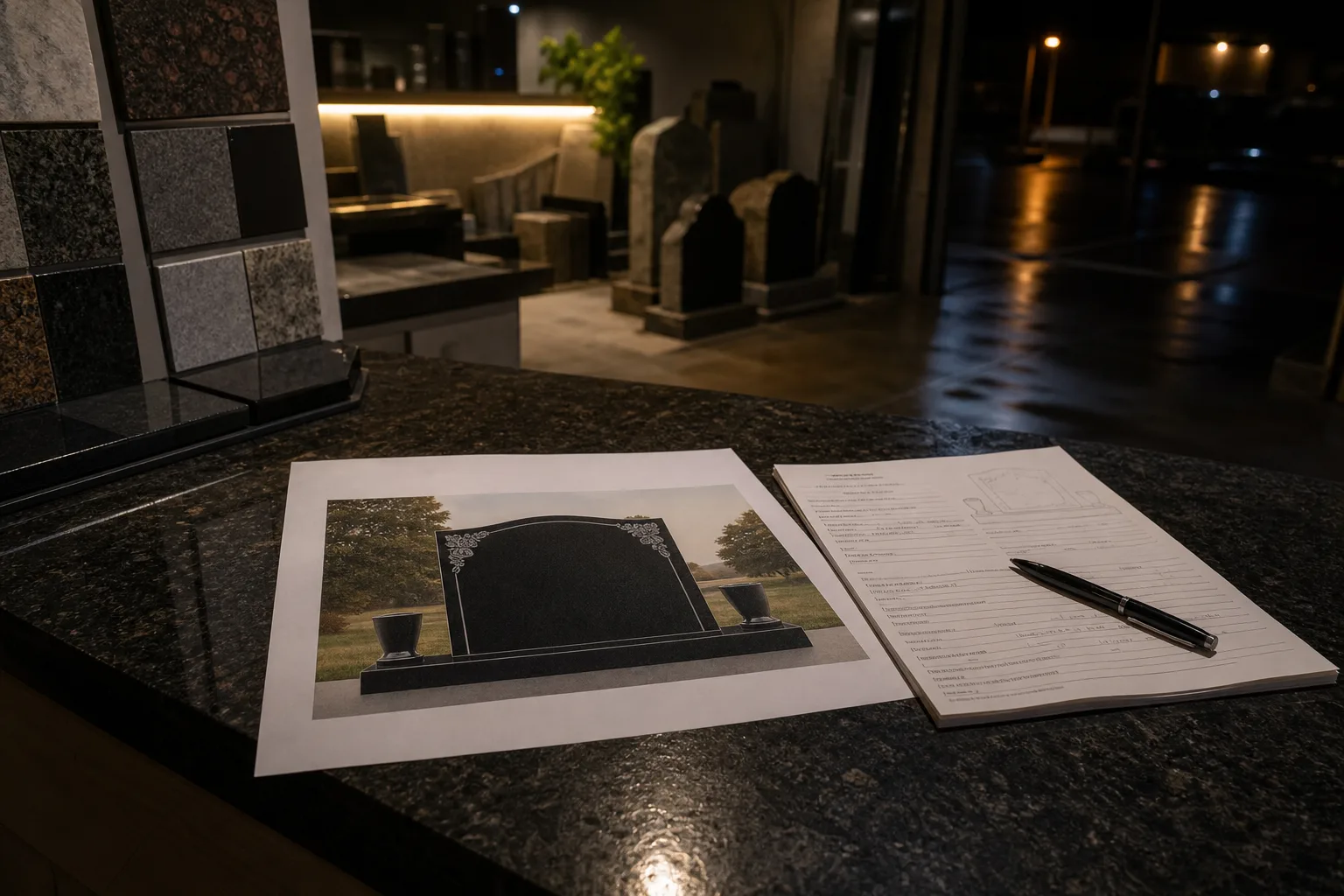
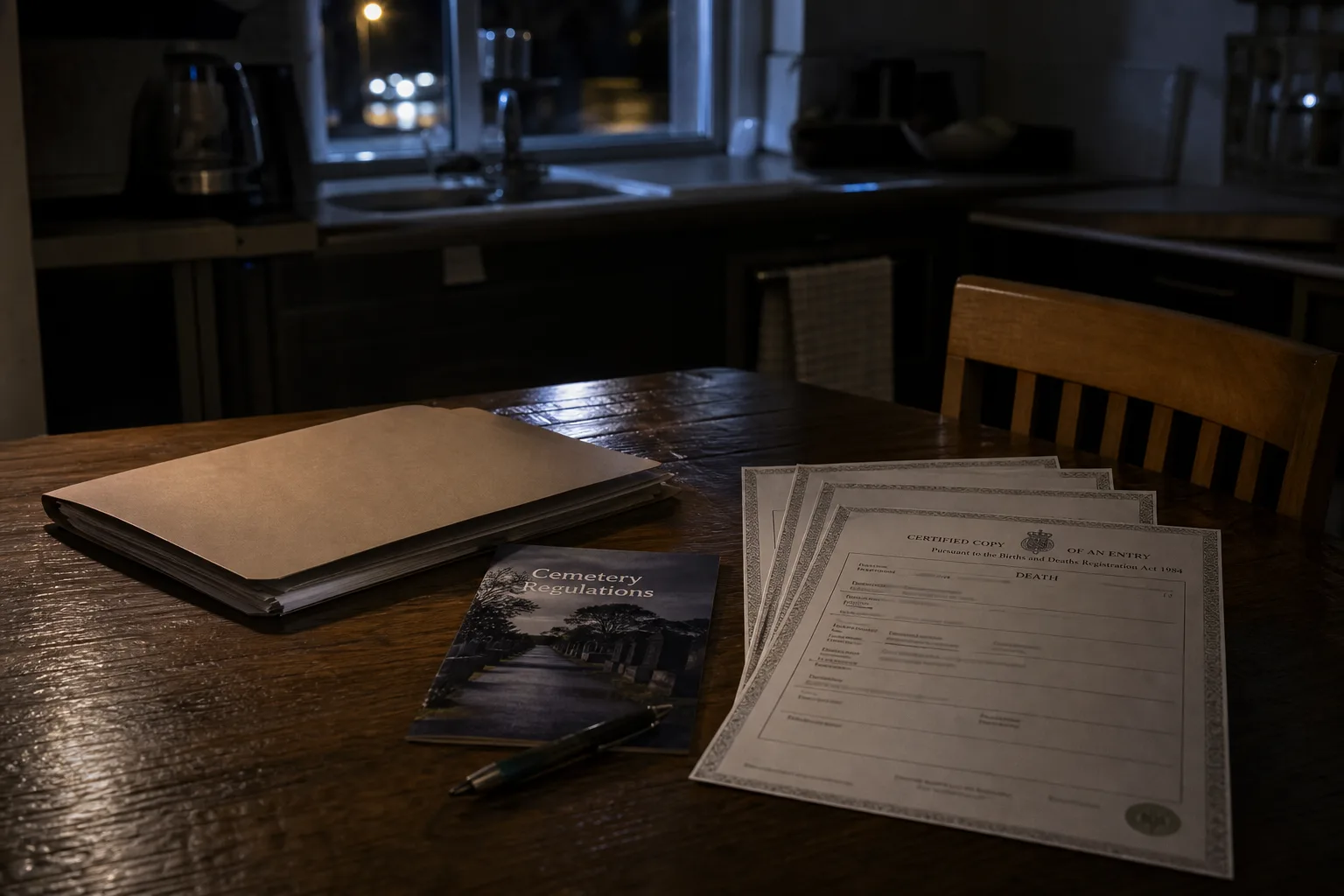
This matters on the first visit rather than the last. The section your family already owns space in has probably fixed the category of memorial, the maximum height, the base dimensions, and sometimes the permitted stone colors, before a designer shows you a single drawing. Ask for the written regulations, not a verbal summary, and read the part about foundations. Families who do this walk into the monument dealer already knowing which half of the catalog is real for them, and the conversation gets shorter, cheaper, and considerably less frustrating.
What the shop is actually doing while you wait
Granite is not manufactured on demand. Quarries pull blocks in campaigns, saw them into slabs, and ship to fabricators who hold limited inventory in the popular grays, blacks, and reds. A common domestic gray in a standard size may be sitting on a rack; an unusual color, an oversized die, or anything requiring a matched pair for a companion marker means waiting for the material before any work begins. Winter quarrying slows in northern climates. Imported stone adds ocean freight and customs to the same sequence. None of this is visible to you, which is why a dealer who gives an honest range rather than a confident single date is usually the more careful one.
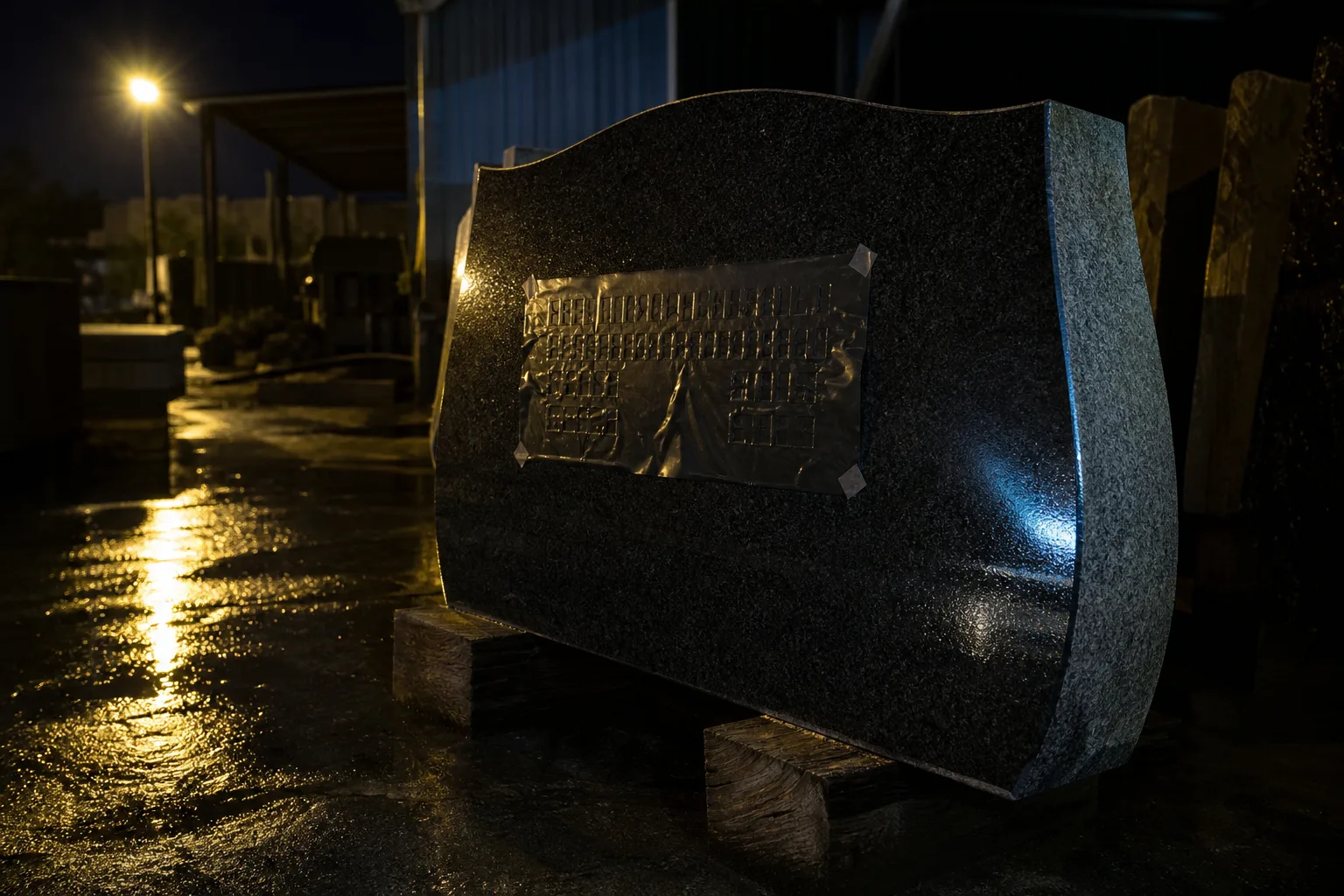
Once the stone exists, the shop work is fast and unforgiving. Lettering is laid out, a rubber stencil is cut and applied by hand, and the exposed areas are sandblasted to depth. Laser etching for portraits and scenes runs on separate equipment with its own queue. A polished face can be repolished only so far, so a misplaced line is not corrected, it is absorbed into a redesign or a replacement blank. That is the practical reason the proof sheet carries so much weight.
The proof is the last afternoon anything is reversible
The drawing you approve is the instruction set. Spelling of a name as it appeared on the birth certificate rather than as the family said it, the exact death date, a middle initial, a nickname in quotes, the spacing between two names when one spouse is still living and the second date will be added decades later: all of that is decided on that sheet. Errors caught after blasting are corrected by filling and recutting, which shows, or by starting over, which costs. Read the proof out loud with a second person holding a document, not a memory. Check the dates twice and the surname three times.
Leave room for the future, literally. If a companion stone will eventually carry a second date, confirm where the letterer will work and whether that panel is reachable in place. Adding an inscription to an installed monument is done in the cemetery, standing over the stone, and the space either exists or it does not. Families who plan the second date at the time of the first almost never regret it, and the incremental cost at design stage is small.
Foundations, frost, and the stones that actually fall over
Installation waits on ground conditions. Most cemeteries require a poured concrete foundation below the frost line, set by their own crew or an approved installer, and they will not pour into frozen or saturated soil. In cold regions that closes the calendar for months, so a stone ordered in late fall is commonly set the following spring. Fresh graves also need time to settle before a foundation goes in, typically several months, which surprises families who expected a marker by the first holiday. Nothing has gone wrong. The delay is what keeps the stone level in five years.
The safety issue worth naming is old uprights, not new ones. Tall Victorian monuments assembled in stacked sections with lime mortar lose their bond over a century, and the injuries that put people in the hospital in cemeteries come from those leaning stones tipping when someone leans, climbs, or steadies a child against them. Modern installations are pinned and set with structural adhesive on a proper base, which is why cemeteries insist on their own foundation specification. If a family stone in an older section rocks when you touch it, report it to the office and keep children clear until a monument crew resets it.
The paperwork that outlasts everyone in the room
Three documents survive the transaction: the interment rights deed, which names who controls the plot and who may authorize changes; the cemetery's rules as they stood when you bought; and the monument order with its approved proof. Keep all three together, because the person who eventually adds the second date will be working from them. Prices for funeral goods and services are governed by federal disclosure rules that the Federal Trade Commission is responsible for enforcing, so ask for itemized figures in writing and compare like with like. Perpetual care funds, held under state law, cover grounds maintenance and not your stone.
A memorial is one of the few purchases a household makes that nobody expects to revisit. The work that makes it durable happens in ordinary weeks: a rules sheet read carefully, a proof checked by two people, a foundation poured when the ground is ready.