Selling in Seven Weeks? The Bathroom Fan Nobody Cleaned and What It Cost to Undo
A hall bath fan left uncleaned for nine years turned into drywall, paint and a plumber's morning, five weeks before a listing date.
- Home & Property
- Clement Boateng
- 847 words, 4 min
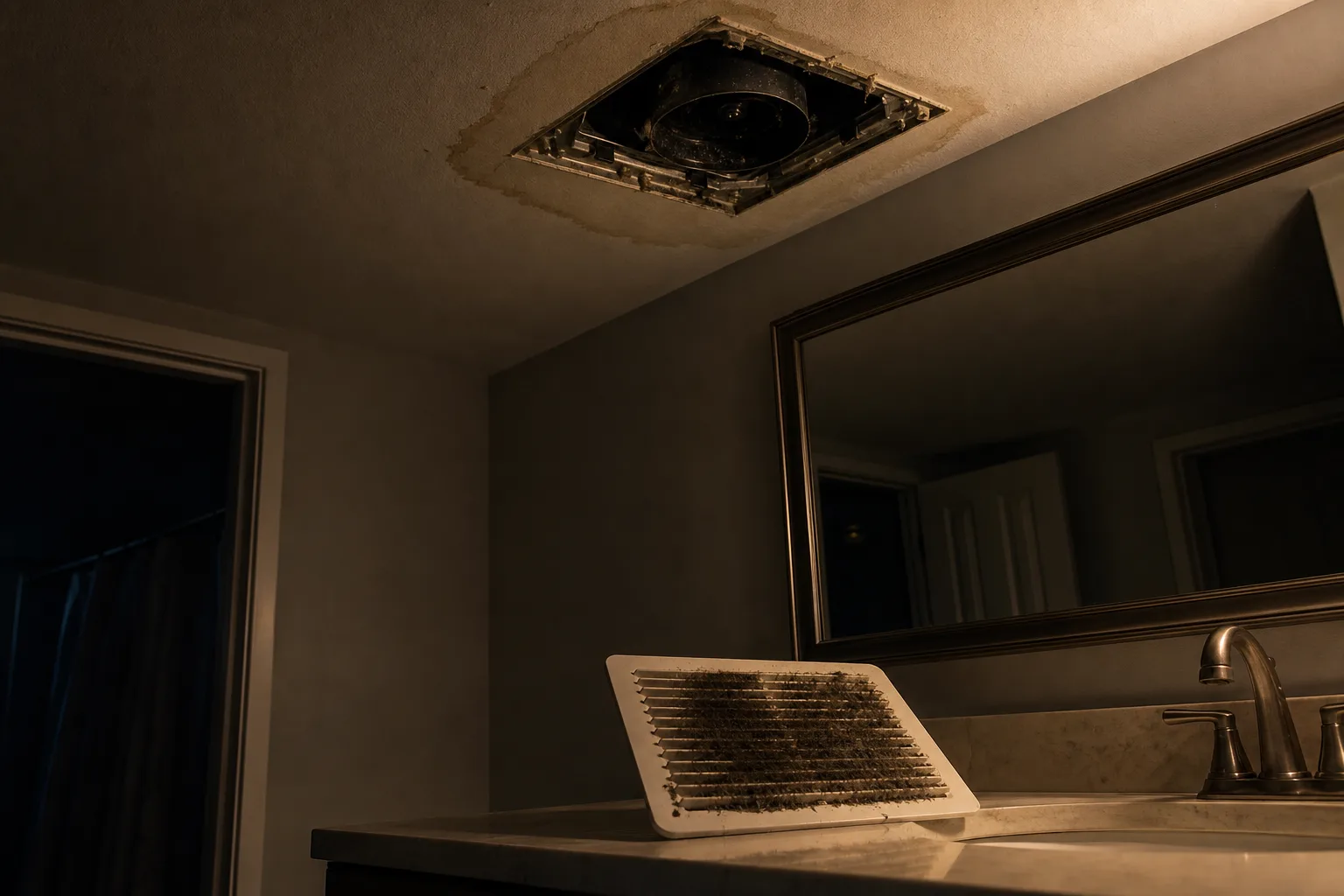
The owner of a two-bedroom condo in a 1990s building called a cleaning company in early spring for what she described as a deep clean before photographs, with a listing date already set for seven weeks out. She wanted the grout brightened and the windows done. What the crew lead flagged instead, twenty minutes into the walkthrough, was the hall bathroom ceiling: a faint brown halo around the exhaust fan grille, roughly the size of a dinner plate, that she had stopped noticing somewhere around year four of living there.
What the grille was actually hiding
The fan still ran. That was the reason it had never come up. But a fan that turns is not the same as a fan that moves air, and this one had been pulling against a mat of lint and dust thick enough to hold its shape when it came off the housing. Above it, the flex duct had sagged into a low belly between two joists, collecting condensate every time someone showered, and the tape at the roof cap had let go at one seam. Nine years of small daily moisture had gone up, cooled, and come back down through the drywall.
None of this was dramatic. There was no dripping, no smell in the hallway, no visible growth on the painted side. On the attic side there was staining on the joist faces and a section of insulation that had been damp and dried repeatedly until it packed down flat and stopped insulating much of anything. The owner's first question was the one most people ask, which is whether the ceiling had to come out. The honest answer, at that point, was that nobody could say without opening a foot of it.
The barely adequate job, and what it leaves behind
There is a version of this repair that takes an afternoon and costs very little. Pull the grille, vacuum the housing, prime the stain with a stain-blocking sealer, roll the ceiling, done. It photographs perfectly. It also leaves the sagging duct, the failed seam at the cap, and the compressed insulation exactly where they were, which means the stain returns on somebody else's watch, usually in the second winter. Several contractors will quote that job cheerfully, because it is what a lot of customers are asking for when they say they need the ceiling to look right before Saturday.
The thorough version treats the fan as a system with three failure points rather than a fixture with a dirty cover. It replaces the flex run with rigid or semi-rigid duct pitched continuously toward the cap so condensate drains out instead of pooling, it seals and insulates that run where it crosses unconditioned space, it confirms the termination is at a roof or wall cap and not simply dumped into the attic, and it verifies the new fan is sized for the room. That last item is where a good contractor asks about the room's square footage instead of matching whatever model was there.
The hazards worth respecting here
Customers who find a stained ceiling tend to worry about the wrong thing first. The Environmental Protection Agency is responsible for federal guidance on indoor air quality and mold in buildings, and its consistent position on limited surface growth is that it is a moisture problem to be fixed and cleaned rather than an emergency to be evacuated. What actually sends people to an emergency room in this category of work is duller: falls from a ladder set on a wet tub surround or a stair landing, and respiratory injury from mixing bleach with an ammonia-based cleaner in an unventilated bathroom, which produces a gas that puts people in the hospital every year. Both are avoidable with a stable platform and one product at a time.
How the customer decided, with five weeks left
She took two estimates. The cheaper one listed paint and a fan. The one she accepted listed the duct replacement, the cap reseal, insulation in that bay, drywall patching to the nearest joists, and a written note that the drywall quantity might grow once it was open, with a stated price per additional square foot so the change would not be a negotiation on the day. That single line, the priced unknown, was what made the higher number legible rather than alarming. The work ran three days including paint cure, well inside her timeline.
Cost fell in a predictable shape. The fan itself was the smallest line on the invoice. Duct, cap and insulation together came to a few times that. Drywall, texture matching and paint, all of it labor, came to more than everything else combined, which is the part that compounds: the mechanical fault stays cheap for years while the finish work it damages does not.
The buyer's inspector noted the bathroom fan as recently replaced and vented to exterior, and moved on. Nine years of a fan nobody cleaned bought her one line of good news in a report, purchased at roughly ten times what a twenty-minute cleaning each spring would have cost.