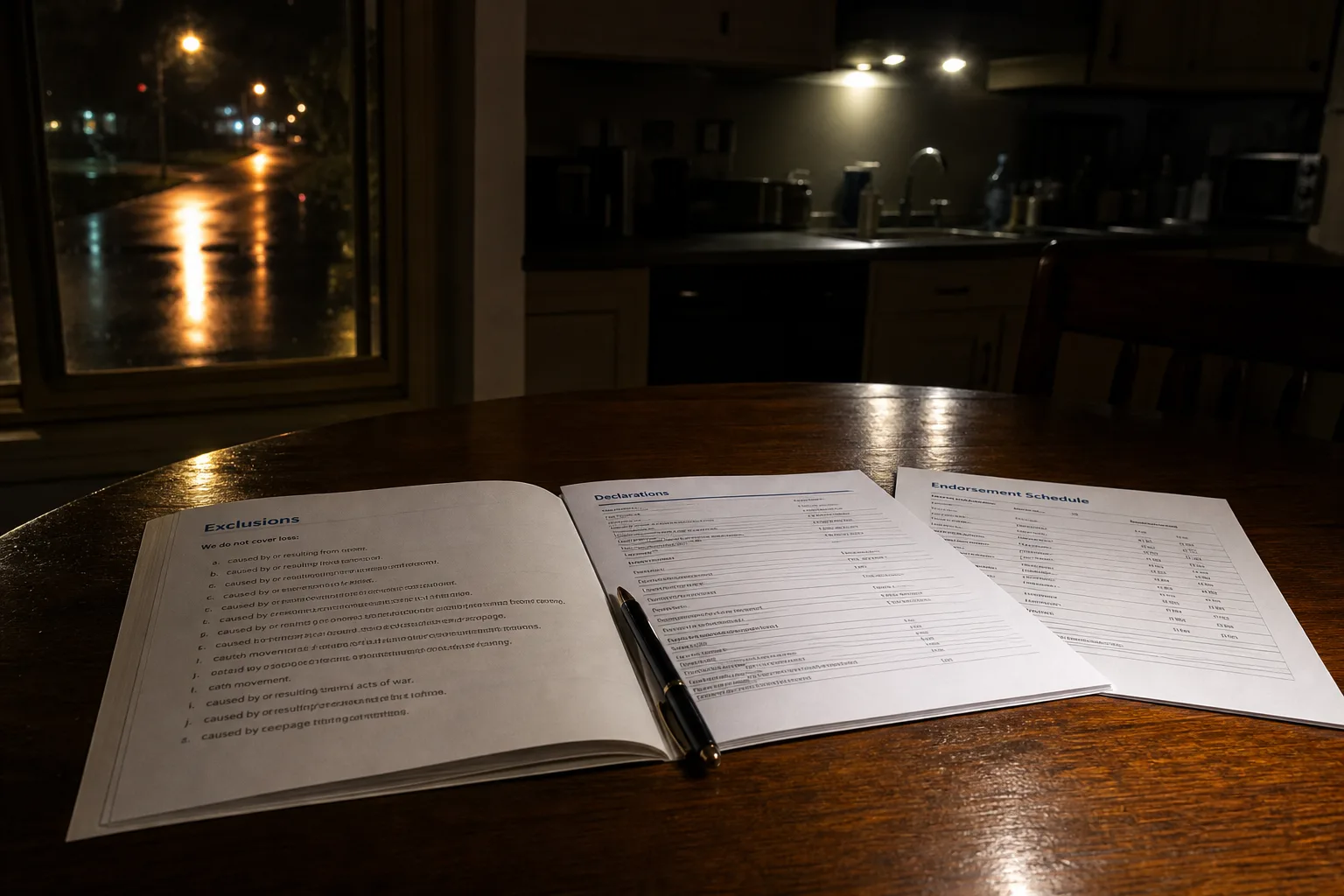
First Policy in Your Hands? Five Checks That Tell You What an Exclusion Actually Removes
An exclusion is rarely a flat no. Five checks show a first-time policyholder what the clause removes, what it gives back, and where the coverage is sold separately.
- Finance
- Ingrid Halvorsen
- 1,011 words, 4 min
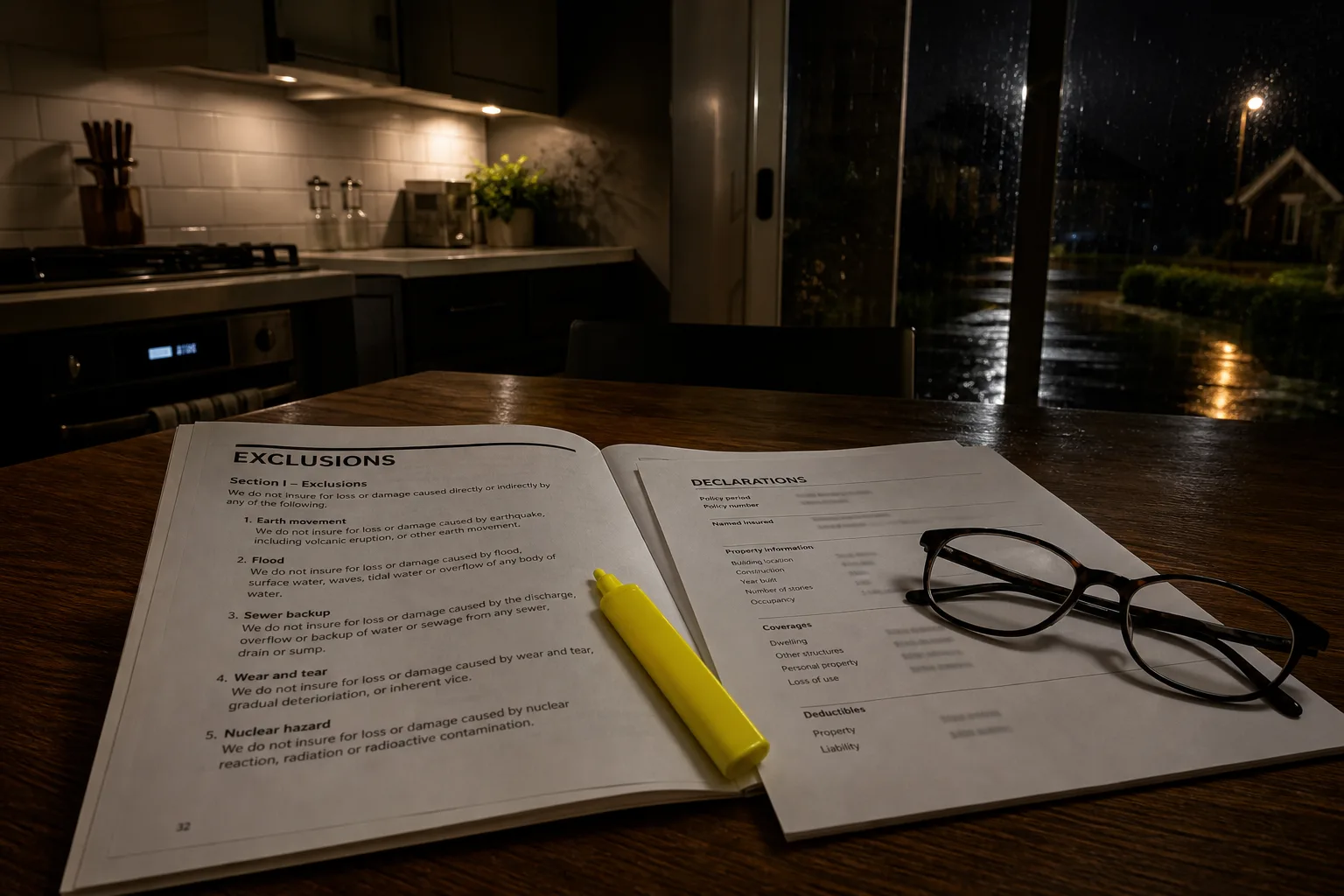
The received wisdom about exclusions is that they are the fine print, that they are written to be unreadable, and that the only rational response is to skim the declarations page and hope. That is half right. Exclusions are dense, and they are not written for pleasure. But they are also the most structured part of an insurance policy, built from a small number of repeating parts, and once you can see the parts you can read almost any exclusion in about ten minutes. Like most jobs, it takes one tool used properly rather than five owned badly.
One. Read the lead-in sentence before you read the list
Every exclusion section opens with a sentence that governs everything under it, and that sentence does more work than the bullet list it introduces. Some lead-ins say the insurer does not cover loss caused by the listed perils, which is narrow. Others say the insurer does not cover loss caused directly or indirectly by those perils, regardless of any other cause or event contributing concurrently or in any sequence. That second version is the one to find first. It means that if an excluded cause is anywhere in the chain, the whole loss can fall outside coverage even when a covered cause was also at work.
A first-time buyer usually reads the list and skips the lead-in, because the list looks like the content. It is the other way around. Two policies can carry an identical flood exclusion and behave completely differently in a storm claim because one of them has that concurrent causation language above it and the other does not. When you are comparing quotes, that sentence is a real difference in what you are buying, and it is worth asking an agent to point to it in both documents side by side.
Two. Chase every capitalized or quoted term back to the definitions
Insurance policies define their own vocabulary, and the defined terms usually appear in quotation marks or bold type wherever they are used. A clause excluding damage from surface water means whatever the definitions section says surface water is, not what you would say if someone asked you at the kitchen table. The same is true of terms like occurrence, residence premises, business, and water damage, each of which carries a definition that can be narrower or much broader than ordinary usage. Skipping this step is the single most common way a first reading goes wrong.
Do it mechanically. Take a highlighter to the exclusion, mark each defined term, then turn to the definitions and read them in order. It is slow the first time and quick every time after. Often the definition is where the coverage you assumed was gone turns out to survive, because the excluded category is drawn tighter than the heading suggested, and the heading is not the operative text.
Three. Find the carve-back, because most exclusions have one
Exclusions are rarely flat prohibitions. They are usually shaped like a wide removal followed by a narrower restoration, and the restoration is introduced by words such as but we do cover, this exclusion does not apply to, or we do insure for ensuing loss. A clause can exclude wear, deterioration, and latent defect, and then give back the resulting damage those conditions cause to other property. The exclusion removes the failed component and the carve-back pays for what the failure ruined. Reading only to the end of the removal gives you a false picture of your own policy.
Carve-backs are where the practical money sits for a homeowner or a small landlord. They decide whether a claim ends at a cracked fitting or extends to the floor, the cabinets, and the drywall underneath. When an adjuster later explains a partial payment, the explanation almost always traces to one of these sentences, so knowing it in advance turns a confusing letter into a predictable one.
Four. Ask which endorsement sells the coverage back
An exclusion frequently exists because the risk is priced and sold separately, not because it is uninsurable. Flood is the clearest example: standard homeowners forms exclude it, and the National Flood Insurance Program, administered by the Federal Emergency Management Agency, is the route that exists to cover it. Water backup from sewers and drains, service line failure, earthquake, ordinance or law upgrades, and equipment breakdown are all commonly excluded on the base form and commonly available by endorsement for a modest addition to premium.
So the useful question to an agent is never whether something is covered. It is which endorsement covers it, what the form number is, what limit it carries, and whether it has its own deductible. That question turns a vague reassurance into something you can verify on the paper you receive. Ask for the endorsement to appear on the declarations page by name before you consider the matter settled.
Five. Check the form number and edition date on every page
Policy forms carry a number and an edition date in small type at the foot of the page, and that identifier tells you which version of the wording you hold. Insurers file these forms with the state insurance department, which reviews and approves them, and editions change over time as wording is revised. A two-year-old comparison article describing an earlier edition may not describe the document in front of you.
Match the form numbers listed on your declarations page against the forms actually attached. Missing pages are common, and you are entitled to the complete policy, endorsements included. Request the full set in writing at binding, keep it as a single file, and you will have the only version of the wording that will matter later.
Run these five checks once on your own policy and you will have read it more carefully than most people ever read theirs. The value shows up in a narrow window: the week after something breaks, when you already know which sentence governs and which endorsement you bought, and the conversation with the adjuster starts from the same page you are looking at.