First Time Hiring Out the Dirty Jobs? Five Checks That Fit a Tight Week
A first-time buyer of cleaning and upkeep labor has days, not weeks, to judge well. Five checks that separate the jobs worth paying for from the ones you can keep.
- Home & Property
- Clement Boateng
- 1,062 words, 5 min

The decision usually arrives compressed. A closing date, a listing photograph, a relative arriving Friday, a landlord's walkthrough scheduled for the end of the month, and suddenly a list of upkeep tasks that had been drifting along for a year has to be resolved in eight days. First-time buyers of this kind of labor tend to make the same error in both directions at once: they hire out the easy, visible work because a quote is simple to obtain, and they keep the work that actually sends people to the emergency room, because it looks like effort rather than risk.
Check what happens if you fall, not what happens if you fail
The honest sorting rule for cleaning and upkeep is height and footing, not difficulty. Interior deep cleaning done badly leaves streaks. Gutter clearing, second-story window washing, roof moss removal and anything performed from a ladder set on wet grass or a sloped driveway carries a different class of consequence, and ladder falls are the injury that reliably fills orthopedic wards every spring and fall. The Occupational Safety and Health Administration is responsible for fall protection standards on job sites, which is precisely why professional crews arrive with stabilizers, standoff brackets and harness anchors that a homeowner does not own. Pay for height. Keep the floor-level work.
The corollary matters just as much on a tight timeline: several tasks that sound alarming are not, in practice, dangerous. Cleaning a bathroom exhaust fan grille, descaling a showerhead, vacuuming refrigerator coils, wiping a dryer's lint housing behind the drum, washing a first-floor storm window from the ground. These read as maintenance you should not touch, and they are the cheapest hours you will ever buy from a professional, which makes them the first things to strike off a quote when the week is short and the budget is fixed.
Check whether the job creates air you have to breathe
The second sorting question is containment. Any task that turns a solid into a suspension puts something into the house that stays there after the crew leaves, and that is where first-timers underestimate what they are buying. Sanding old painted trim in a house built before 1978, disturbing an attic where insulation has been walked on, scrubbing visible growth off a basement wall after a slow leak, clearing out a crawlspace with rodent droppings in it. Professionals in these categories are not selling scrubbing; they are selling negative air, plastic barriers, respirators and disposal, and the containment is most of the invoice.
What tips the judgment is duration of occupancy. If you are cleaning a rental you are leaving in a week, the calculus differs from a house where a toddler will be crawling on that floor for a decade. Ask any bidder what they do to keep dust out of the rest of the house, and listen for specifics: where the barrier goes, whether the HVAC gets shut down and taped, how debris leaves the building. A crew that answers with process rather than reassurance is the one to book, and that single question does more sorting than three price comparisons.
Check the chemistry before you check the price
The other injury that genuinely lands people in hospital from household cleaning is respiratory, and it comes from mixing. Bleach with ammonia, bleach with acidic descalers, and enthusiastic combinations of drain products in a closed bathroom with the door shut and the fan not running. First-timers hire out heavy cleaning and then work alongside the crew with their own bottle of something, which is exactly the scenario where two competent products become one bad afternoon. If someone else is cleaning, let them own the chemistry for the duration, and ask what they are using in the small rooms.
This is also where a professional earns money invisibly. Grout haze, hard-water etching on glass, oxidized aluminum thresholds, sealed stone that has been stripped by the wrong pH: all of these are damage a first attempt causes and a second visit cannot undo. On a compressed timeline the relevant comparison is not the hourly rate against your Saturday. It is the rate against the cost of replacing a surface you ruined trying to save it, which is the arithmetic that makes stone, tile and specialty flooring the clearest hire on any list.
Check who carries the insurance and how you would know
Ask for a certificate of insurance sent directly from the agency that issued it, with general liability and workers' compensation both shown, and check that the named insured matches the name on the estimate. This takes one email and it is the strongest signal available in a week where you cannot collect references at leisure. Uninsured labor on ladders and roofs transfers the injury risk to your homeowners policy and, potentially, to you personally. A crew that produces the certificate the same day is telling you something accurate about how the rest of the job will run.
While you have their attention, confirm two more things in writing: who is actually coming (a named crew, a subcontractor, a day-labor pickup) and what happens to the debris. Haul-away is the line item that quietly separates two otherwise identical bids, and disposal fees for roofing granules, saturated insulation or a garage full of paint cans are real. Getting both answers by text is enough. You are not building a file for litigation; you are testing whether the person answers precisely under mild pressure.
Check the sequence, because the order sets the cost
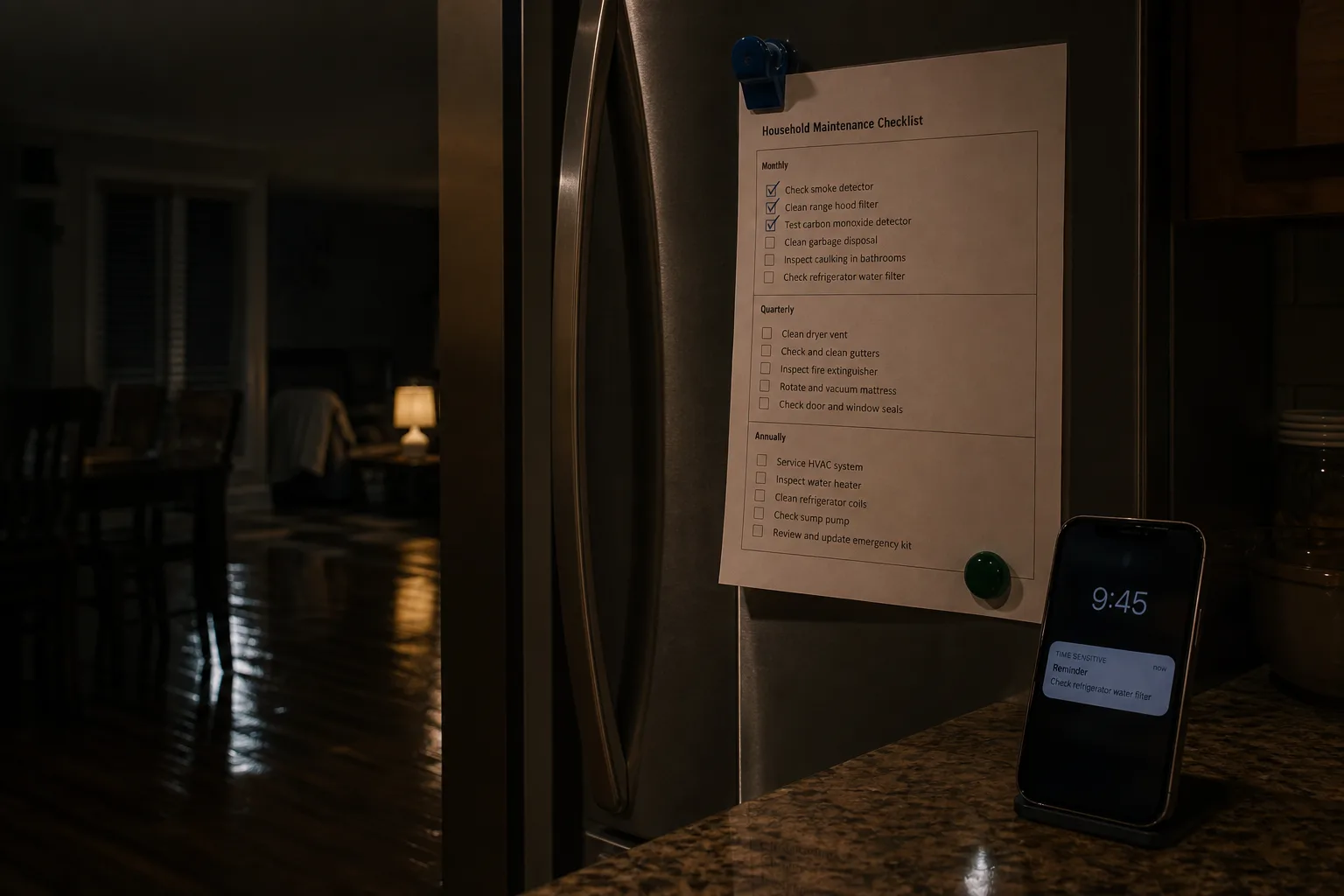
Upkeep tasks have dependencies, and a first-timer's instinct is to book whatever has the earliest availability. Gutters before roof work means paying twice. Carpet cleaning before the crawlspace is cleared means tracked debris on damp fiber. Window washing before exterior painting is money set on fire. Sit down with the list and put the dirty, high, and dusty work first, the wet work second, and the finish cleaning last, then book backward from your deadline with a buffer day for the one crew that will slip.
Judgment here is not innate and it does not require a season of practice. It requires asking, of every task, three questions in order: can I fall doing this, does it put something in the air, and can I ruin the surface. Anything answering yes to any of those is worth paying for, and the rest is yours.