Gutters, Chimney, Septic. The Five Upkeep Jobs Worth Hiring Out, and What Sets the Price
The household chores that justify a paid crew, what actually drives the quoted price, and how county rules change the number before anyone climbs a ladder.
- Home & Property
- Clement Boateng
- 1,475 words, 6 min
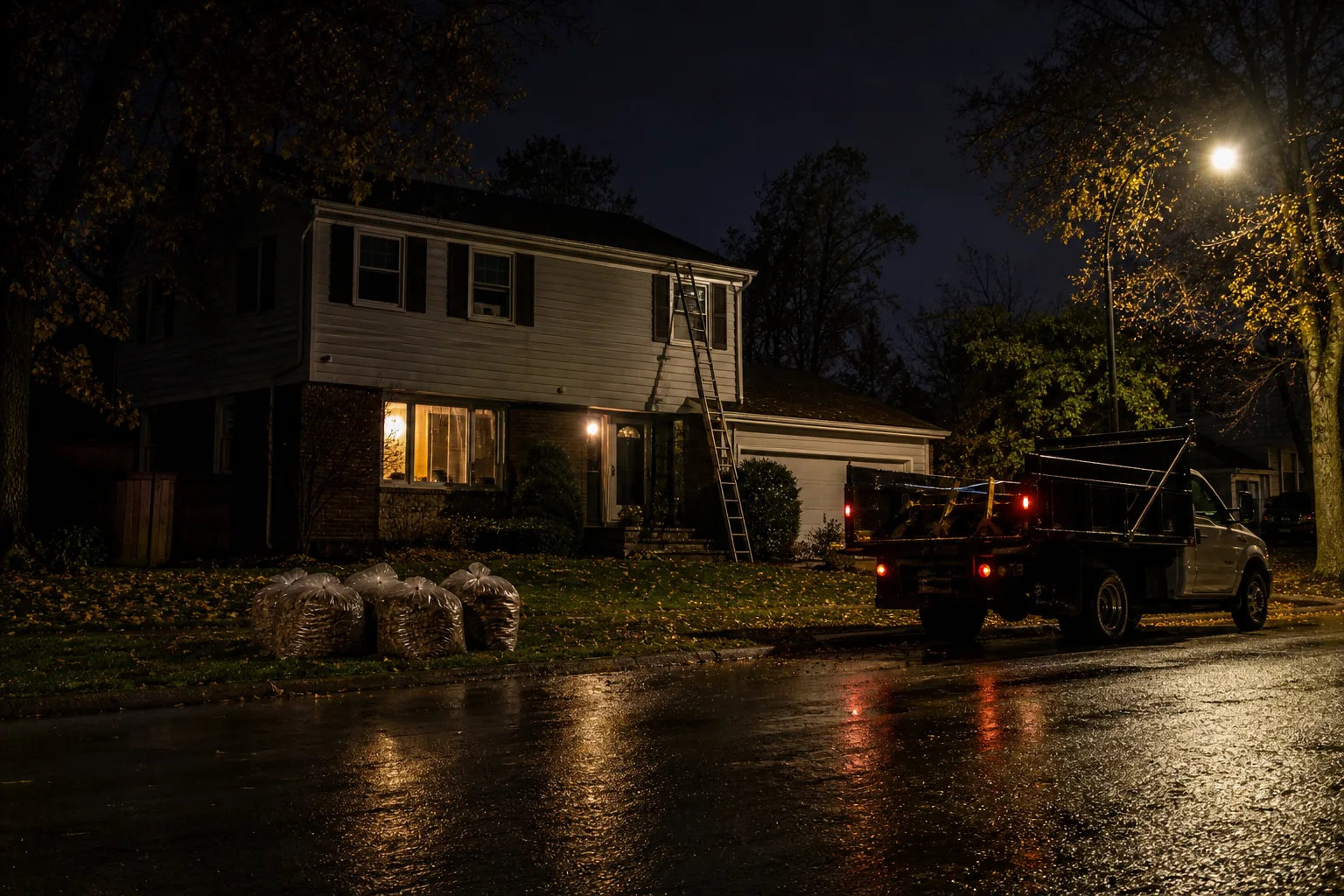
The received wisdom about home upkeep is that anything without wiring or plumbing behind it belongs to the homeowner, and that hiring out a cleaning job is a small surrender. That was largely true for a generation that owned a wooden ladder and a single-story ranch, and it still holds for plenty of work. What it misses is that a handful of routine jobs carry either a real injury risk or a local rule attached, and those two facts, more than the difficulty of the work itself, decide whether paying someone is sensible. The prices follow patterns you can predict once you know what a contractor is actually pricing.
1. Gutters and downspouts, where the price follows the roofline and the ladder
Falls from ladders are the injury that fills emergency rooms in this category, and they cluster in a narrow set of circumstances: a ladder footed on soft ground or a driveway slope, a homeowner reaching sideways past the rails rather than climbing down and moving the ladder, and a second story instead of a first. The Occupational Safety and Health Administration sets the fall protection standards that govern crews doing this work for pay, which is one practical difference between a hired team and a Saturday afternoon. The debris itself is harmless. The height is not.
Gutter cleaning is priced on linear feet of gutter, the number of stories, and roof pitch, in roughly that order. A single-story house with an accessible perimeter is a short visit and a small bill; add a second story, a steep pitch that forces work from the ladder rather than the roof, or a section over a deck or a bay window, and the same footage can double. Gutter guards cut the frequency but raise the per-visit price, since sections have to be unclipped and reseated. Ask whether downspout flushing and a photo of the discharge point are included, because that is where blockages usually sit.
Region changes the schedule more than the rate. In the upper Midwest and New England, the visit that matters is the late fall clearing before ice dams form, and crews book out accordingly. In the Southeast, pine needles mean two or three visits rather than one. On the West Coast, moss and fir debris keep gutters loading through a long wet season. Some homeowners associations specify how often gutters must be cleared and will send a letter about staining on the fascia, which is a cost driver hiding in a covenant rather than a price list.
2. Chimney sweeping and inspection, where the code is written locally
Chimney fires and carbon monoxide are the two outcomes worth taking seriously, and both are quiet problems with an obvious inspection point. Creosote builds on a schedule set by what you burn and how cool the flue runs, so a household burning unseasoned wood in a slow-drafting insert needs attention far sooner than one burning a few clean fires a winter. Gas appliances need the flue checked too, because a blocked or deteriorated liner is what puts combustion products back into the house. A sweep and a Level One inspection are usually sold together.
The price is set by the appliance and the access. A straightforward open masonry fireplace on a single-story house is the low end. A wood stove insert that has to be pulled and reset, a tall or offset flue, an exterior chimney reached only from a steep roof, or a second flue in the same stack all move the number up, and a camera scan of the liner is typically a separate line. Repairs found on inspection, a cracked crown or a failed liner, are a different order of expense and should be quoted independently rather than folded into the sweeping visit.
Local rules matter here in a way they do not elsewhere. Several western counties with winter air quality problems restrict solid fuel burning on designated days and require certified appliances at the point of sale or transfer, which means an inspection report can become a condition of closing. Some jurisdictions require a chimney inspection before a wood-burning appliance changes hands, and many insurers ask for a dated sweep record. A homeowner in a curtailment county is often buying documentation as much as a clean flue, and the sweep who works there every day knows which form is wanted.
3. Septic pumping, where the county health department sets the interval
This is the job most clearly worth hiring out, because there is no version of it a homeowner performs. Tank gases are genuinely dangerous in confined spaces, and the accidents that occur involve people opening a lid and leaning in, which is a reason to leave the cover alone entirely. The Environmental Protection Agency oversees the national framework for onsite wastewater systems, with the operating rules written and enforced by state and county health departments, and those departments are where the pumping interval you are held to actually comes from.
Cost is driven by tank size, the depth and accessibility of the lid, whether a riser has been installed, how far the truck has to haul the load, and what the receiving treatment plant charges to accept it. Rural properties a long drive from a disposal site pay noticeably more than suburban ones on the same tank volume. Digging to find a buried lid adds labor, and installing a riser during one visit pays for itself across the next several. Filter cleaning and a written report on sludge depth are cheap additions that give you a defensible record.
The regional spread is wide. Some counties, particularly in coastal watersheds and around lakes, require pumping on a fixed cycle with a certified report filed, and a few require an inspection at the time of sale. Others leave the interval to the homeowner's judgment. If your property sits in a designated watershed protection area, the paperwork is part of the service, and hiring a hauler already licensed in that county is the difference between a filed report and a repeat visit.
4. Roof moss and exterior washing, where water rules change the method
The safety case is the same as gutters, with the addition that a mossy roof is slick and that walking a wet composition roof damages it. The real argument for hiring out roof cleaning is technique. Pressure washing shingles strips granules and shortens the roof's life, so competent crews use low-pressure chemical treatment and let rain rinse it, which is a slower and less satisfying process that leaves the roof intact. Pricing follows roof area, pitch, story count, and how much overhanging tree cover is feeding the growth.
Local rules bite hardest on the runoff. Municipal stormwater programs in a number of cities require washwater to be captured and kept out of storm drains, particularly for driveway and building washing, and contractors working under those rules carry reclaim equipment that shows up in the quote. Water restrictions in parts of the Southwest limit exterior washing outright during drought stages. In the Pacific Northwest, moss treatment is close to an annual necessity; in Arizona it is not a line item at all. Ask a bidder which rule they are working under, because the answer explains the price gap between two otherwise similar quotes.
5. Limbs over the roof, where the tree crew earns the difference
Chainsaw injuries and falls from trees are serious and common enough to settle this one quickly. Anything requiring a ladder, a saw above shoulder height, or a limb that will land on a roof, a fence, or a service drop belongs to an insured crew with a certified arborist on staff. Cost is driven by tree height and species, proximity to the house and power lines, whether a bucket truck can reach the work or a climber is required, and disposal, since haul-away and dump fees are frequently the largest single component.
Municipal rules shape this more than people expect. Many cities regulate the removal of trees above a certain trunk diameter and require a permit, some protect specific species, and utility easements often mean the power company handles clearance near the line at no charge if you ask. Coastal and hurricane-prone counties see pricing swing hard after a storm, and a pre-season trim booked in the quiet months is both cheaper and more carefully done.
The common thread across all five is that the quote is answering a question about your specific property: how high, how far to haul, which county, and what has to be filed afterward. A bidder who walks the site, names the rule they are working under, and puts the disposal and paperwork on the estimate as separate lines is giving you a number you can compare against another one. That is the point at which hiring the work out stops being a surrender and starts being a decision.