A Slow Drain, a Private Sewer Lateral, and the City Rule That Decided the Bill
A duplex owner ignored a sluggish drain for four years. What separated the adequate cleaning from the good one, and how the local ordinance set the final price.
- Home & Property
- Farah Siddiqui
- 1,223 words, 5 min
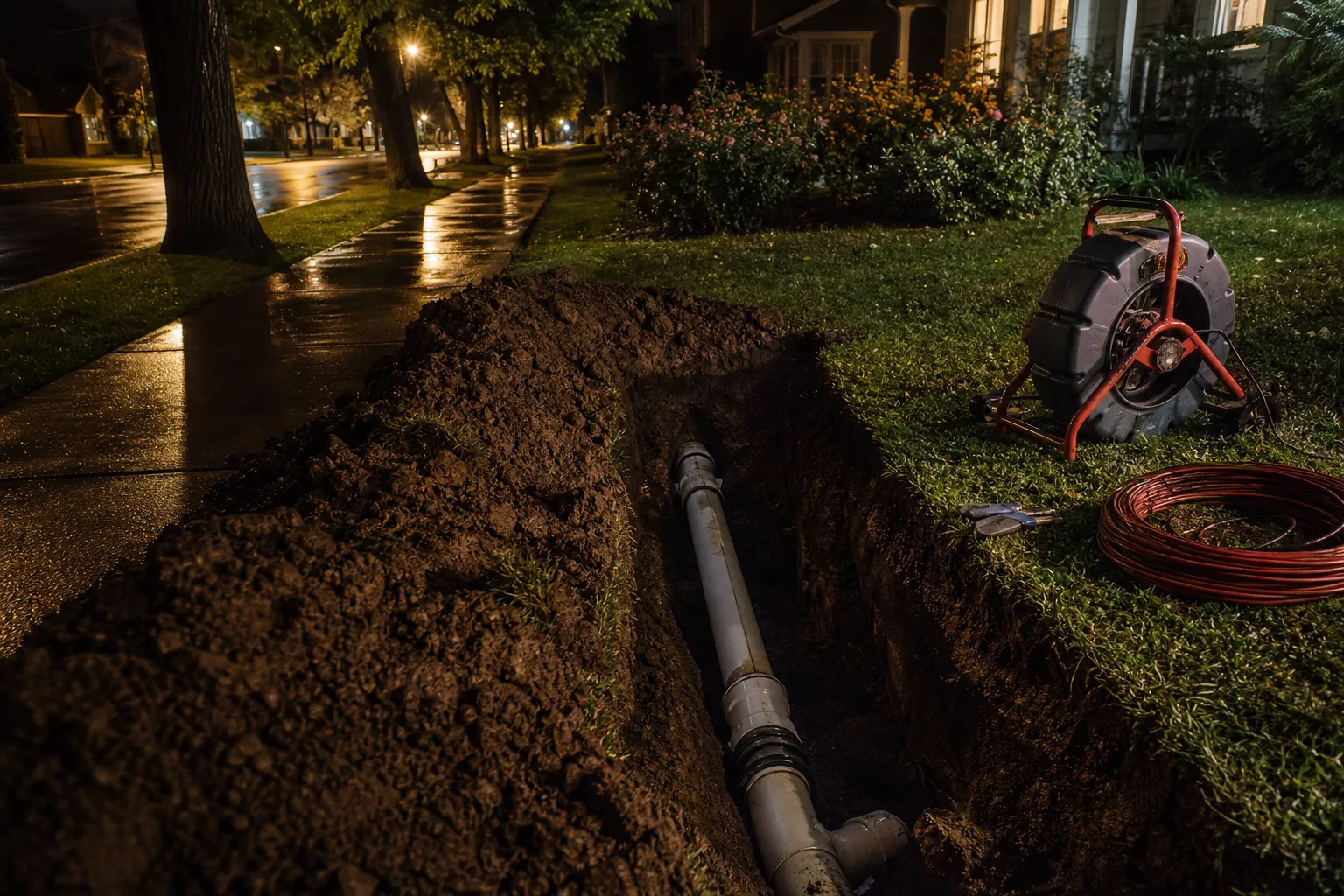
The drain in the downstairs unit of a two-family house had been slow for years, in the way that plenty of drains are slow, and the owner treated it as a quirk of an older building rather than a symptom. A plumber cleared it the first time for a couple of hundred dollars, cabled it again eighteen months later, and told her on the second visit that something was growing into the line. She heard the price of a camera inspection, declined it, and moved on. Four years after that first slow drain, she was paying to replace the sewer lateral under her front yard and the sidewalk, and paying an emergency premium on top.
What the neglect actually compounded
The failure here was not the roots. Roots find clay joints and old cast iron everywhere, and every city with mature street trees has a plumbing trade built around them. What compounded was the absence of information. Cabling a line clears a channel through an obstruction and restores flow; it does not tell anyone what the obstruction is, how much of the pipe is left, or whether the line has begun to sag into a low spot that will collect solids forever after. Each clearing bought roughly a year of normal drainage and taught the owner nothing, so each year the decision she faced was the same decision, made with the same missing facts.
By the time the line backed up into the downstairs unit's shower, the situation had changed from a maintenance question into an emergency with a tenant in it. She was no longer choosing between repair options on a schedule she controlled. She was choosing between whatever a crew could start within forty-eight hours and a habitability problem, and the price of a job you cannot postpone is not the price of the same job in March. The compounding was in the loss of timing, more than in the extra feet of damaged pipe.
The barely adequate job and the good one
Both jobs are legitimate work performed by licensed people, and on the invoice they can look similar. The barely adequate version is a cable through the cleanout, a running toilet as proof of flow, and a line on the receipt that says drain cleared. The good version starts the same way and then puts a camera down the cleared line, records the footage, marks the distance from the cleanout where each problem sits, and locates the trouble spot on the surface with a transmitter so that the owner knows whether the bad section is under the lawn, under the driveway, or under the public sidewalk.
That distinction is worth real money because it converts an open-ended risk into a bounded one. An owner who knows the break is twenty-two feet out, in the grass, is looking at a spot repair she can schedule and shop. An owner who knows nothing is one backup away from a crew digging exploratory holes at an hourly rate. The good job also uses the right tool for the right defect: cabling cuts a hole through roots, while hydro jetting scours the pipe wall and gives the next intrusion something further to travel. Ask which one is being sold, and why.
The other marker is what the contractor puts in writing about scope. A good proposal states the length of pipe to be replaced or lined, the depth, the restoration of the surface above it, whether the permit and inspection fees are included, and who pays if the excavation reveals more bad pipe than the camera showed. A thin proposal states a price. The Environmental Protection Agency oversees the sanitary sewer systems these private lines connect into, and the seriousness with which a municipality treats that connection tends to show up in exactly these details.
Where you live decides who owns the problem
The single largest variable in a case like this is not the plumbing. It is the local rule about where the property owner's responsibility ends. In much of the country the owner owns the lateral all the way to the main in the center of the street, which means the sidewalk, the curb, the tree lawn, and the traffic control to dig in the roadway all sit on the owner's side of the line. In other jurisdictions responsibility stops at the property line or the curb, and the utility handles what lies beyond it. Same broken pipe, same crew, and a difference in the bill that can run to multiples.
Local rules also decide when you are forced to act. A number of cities and sewer districts run point-of-sale or point-of-transfer programs that require a camera inspection of the private lateral before a house changes hands, with repairs completed or escrowed at closing. Others require a backwater valve when a fixture sits below the elevation of the upstream manhole, or offer cost-sharing and low-interest loan programs to owners who replace deteriorated laterals voluntarily, because infiltration into private lines is what overwhelms the treatment plant in a storm. Those programs are real money left sitting on the table by owners who never called the sewer district before hiring anyone.
The practical step is unglamorous and takes an afternoon. Call the municipal wastewater or public works department, ask where the owner's responsibility ends on your street, ask whether a permit and a licensed drain layer are required, ask whether any assistance or deferred-payment program exists, and ask what the sidewalk restoration standard is if the trench crosses it. In this case, the owner learned after the fact that her district ran a lateral replacement loan at a rate well below anything a contractor's finance partner would have quoted, and that it was available only for planned work.
How it got paid for, and what waiting cost
She paid with a contractor-arranged installment plan taken at the kitchen table on the day of the backup, because it was the option in front of her. Point-of-sale contractor financing is convenient by design, and the convenience is priced in: the promotional period is short, the rate after it is a credit-card rate, and the deferred-interest structure common in home improvement lending charges the interest back to day one if the balance is not cleared in time. A home equity line drawn a season earlier, or the district's loan, would each have carried a fraction of that cost.
Insurance did not close the gap either. Standard homeowners policies exclude damage from water backing up through sewers and drains unless a sewer backup endorsement has been added, and they exclude the repair of the failed pipe itself in almost every case. The endorsement is inexpensive and has to be in place before the loss. So the true cost of four years of not spending a few hundred dollars on a camera included the emergency labor premium, the higher borrowing rate, the uninsured cleanup in the downstairs unit, and a month of abated rent.
She had the new line inspected and recorded before the trench was closed, put the footage in the property file, and set a jetting interval based on what the camera showed rather than on when the shower next drains slowly. The next owner of that duplex will pass the district's point-of-sale inspection without a scramble, which is worth something at closing that nobody itemizes.