Your First Water Loss, Hour by Hour. The Rules That Decided What Got Saved
A burst supply line on a Friday night, and the standards, policy clauses and paperwork that quietly determined which parts of the house dried out and which came out in pieces.
- Home & Property
- Clement Boateng
- 1,015 words, 4 min
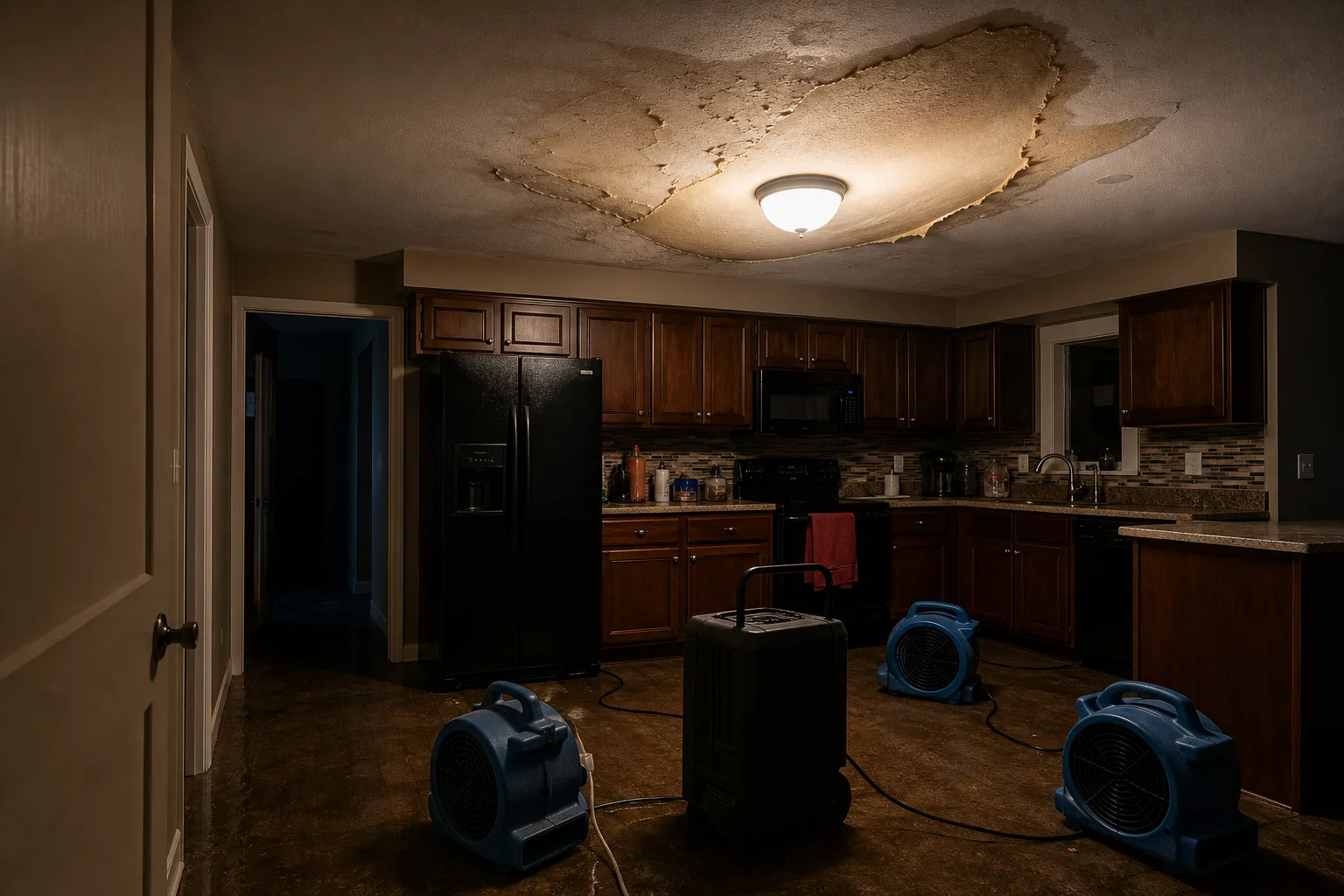
The line running to a second-floor toilet let go at about seven on a Friday evening, and by the time anyone noticed, water had found the ceiling of the kitchen below and was coming through the seam where the drywall met the light fixture. The owners had closed on the house eleven months earlier and had never made a claim on anything. What happened over the next two days was decided less by how fast they moved than by a handful of rules they did not know existed: an industry standard for drying, a clause in their policy, and one piece of paper they signed at eleven at night without reading it properly.
The first decision was electrical, and it was the only one that could have hurt anyone
Water was running down a ceiling that contained a wired fixture and a junction box. That is the hazard in a residential water loss that actually sends people to the hospital: energized circuits in contact with wet building materials, and people standing in the water while they reach for a switch. The correct move is to kill power to the affected circuits at the panel, and to do it from a dry position, or to have the utility or an electrician do it if the panel itself is wet or if the water is anywhere near the service entrance. Everything else can wait ten minutes. This one cannot.
The second real hazard is footing. Wet hardwood over a stair tread, a soaked area rug on tile, a ladder set on a floor that has started to cup. The owners in this case sent one person for the main water shutoff and kept the other off the stairs entirely until the flow stopped. Nobody went into the attic. Nobody pushed on the bulging section of kitchen ceiling to drain it, which is a common instinct and a poor one, because saturated drywall comes down as a sheet with the fixture attached.
What the water was classified as, and why that answer set the whole scope
Restoration contractors work to a consensus standard for water damage, the S500, which sorts water into categories by contamination and sorts the affected space into classes by how much material is wet and how hard it will be to dry. Clean supply water is category one. Water that has passed through building materials, or picked up soils, or has been sitting, degrades toward category two. Sewage and floodwater are category three and are handled as a health matter, with removal rather than drying as the default for porous materials. The distinction is not academic. It decides whether carpet pad, insulation and drywall are dried in place or cut out and thrown away.
That degradation is exactly why the first forty-eight hours carry the weight they do. Category one water sitting in a wall cavity at room temperature does not stay category one. In this case the technician who arrived Saturday morning documented clean supply water, took moisture readings in the kitchen ceiling, the wall below the bathroom and the subfloor, and set air movers and a dehumidifier rather than opening walls. Two small inspection holes were cut low on the kitchen wall. The ceiling drywall came out, because it had been saturated and hung, but the cabinets and the subfloor were dried and monitored, and they were kept.
The policy said to mitigate, and the paperwork said who was owed money
Nearly every homeowners policy carries a duty on the insured to protect the property from further damage after a covered loss, and reasonable emergency costs incurred to do that are generally payable. That obligation is why calling a restoration company at ten at night is not jumping the gun and is not something an adjuster penalizes. What the owners were not ready for was the document put in front of them: a work authorization with a direct-payment assignment, open-ended as to scope, signed before anyone from the insurer had seen the house.
They signed it, and it worked out, because the company scoped the job with the adjuster on Monday and billed within that scope. The version that goes badly is the one where the authorization has no scope limit, the equipment runs for nine days on a three-day job, and the homeowner is left arguing over the difference. A first-timer can head that off in a minute: write on the form that authorization covers emergency mitigation only, pending insurer approval of any further scope, and initial it. Photograph every room before equipment arrives. Keep the failed supply line in a bag.
What was not an emergency, despite how it felt
The owners spent Saturday afternoon worried about mold, which is the fear that arrives first and the one least useful in the first two days. Mold is a moisture-duration problem, and the answer to it is drying the structure quickly and completely, which is precisely what the equipment in the kitchen was doing. The Environmental Protection Agency is the federal body responsible for guidance on indoor mold and moisture, and its consistent position is that controlling moisture is the control for mold. Nobody needed a mold test on day one. What they needed was a dehumidifier running and daily moisture readings written down, which they had.
They also worried about the ceiling joists, which were wet and stayed wet longer than anything else, and about whether the floor above would need to come up. Neither turned out to be structural. Framing lumber tolerates a short wetting and dries. The readings came back to dry standard on the sixth day, the ceiling was patched, and the file closed with the deductible as the only out-of-pocket cost.
The useful part of this case is how little of the outcome depended on speed alone. Power off, water off, nobody on the stairs, a documented water category, moisture readings from the start, and a scope-limited signature. Those six things are available to somebody who has never done this before, at eleven at night, with a wet kitchen and no idea who to call first.